Official economic evaluations released by provincial tourism authorities demonstrate that cruise tourism has established itself as an indispensable driver of economic expansion in South Africa. Findings presented at the Cruise Cape Town Annual Review reveal that the maritime passenger industry contributed a cumulative R5.7 billion to the gross domestic product of the Western Cape over four consecutive seasons. The comprehensive economic assessment illustrates the industry’s expanding role in sustaining formal employment, elevating household earnings, and generating vital revenue across both urban and rural hospitality value chains.
During the 2025/26 maritime season, direct and indirect tourism activities injected R1.35 billion into provincial gross domestic product, while total sector expenditure reached R1.47 billion. These returns confirm that maritime arrivals extend far beyond harbour dockings, distributing commercial benefits to tour guides, transport operators, food and beverage producers, cultural institutions, and regional retail artisans across the province.
Resilient Passenger Volumes and Continental Port Leadership
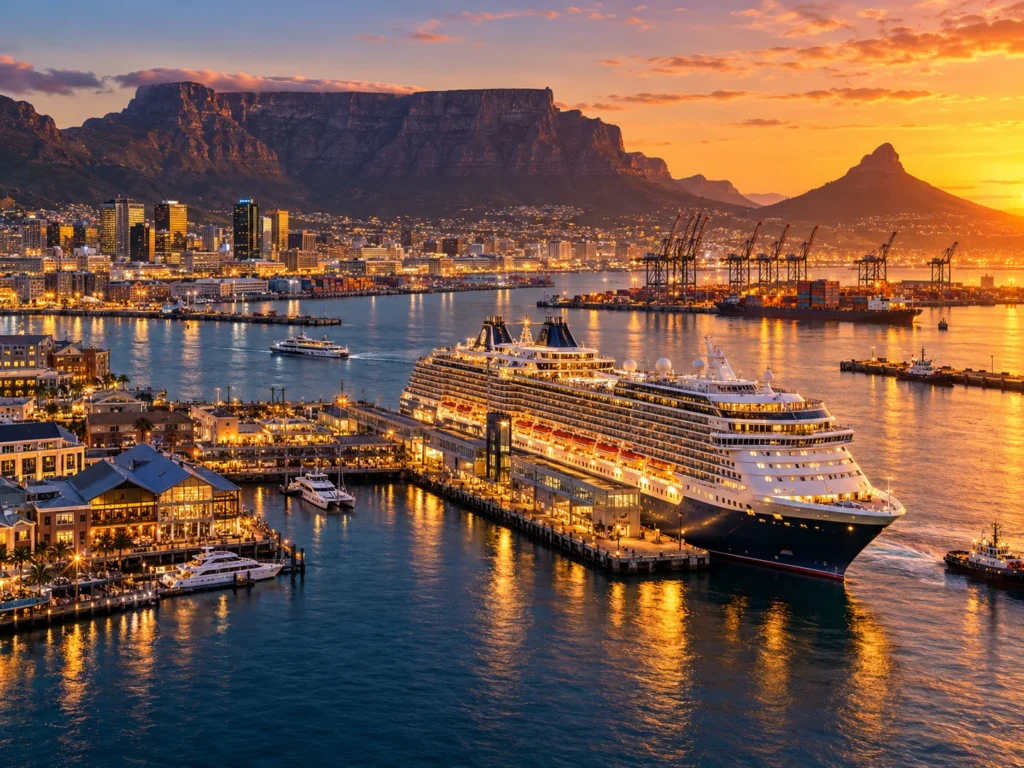
Operational records from the Port of Cape Town indicate sustained maritime appeal despite broader international navigational challenges. Throughout the 2025/26 season, the port accommodated 64 cruise vessels carrying 106,240 passengers and 37,200 maritime crew members. While global maritime route adjustments caused selective itinerary alterations, overall passenger volumes remained higher than the totals achieved during the 2022/23 and 2023/24 periods.
The terminal also registered its second-highest recorded volume of embarking and disembarking voyagers, underscoring Cape Town’s established role as a premier turnaround destination for long-haul global itineraries. International recognition accompanied these throughput achievements, with the Port of Cape Town retaining its position as Africa’s Leading Cruise Port at the World Travel Awards for the fourth straight year.
Sustained Employment Generation and Fiscal Contributions
The economic evaluation emphasizes that the value of maritime passenger operations is reflected in broad socio-economic indicators. Across the four analyzed seasons spanning 2022/23 through 2025/26, cruise activities supported an annual average of 7,875 full-time equivalent employment opportunities. Total household income generated over this four-year span reached R2.76 billion, directly improving the financial well-being of families across the Western Cape.
The sector additionally delivered R791 million in cumulative tax revenue to the national fiscus. In the 2025/26 period alone, the cruise economy supported an estimated 1,700 full-time equivalent positions within the Western Cape, contributing to a broader national impact of 2,151 full-time equivalent jobs across South Africa.
Provincial economic leadership affirmed that these benchmarks align directly with the provincial Growth for Jobs Strategy, illustrating how public infrastructure management and private commercial operations can collaboratively generate stable community employment. Municipal leaders similarly noted that spending by arriving voyagers provides vital cash flow for small, medium, and micro-enterprises operating throughout the metropolitan area.
Regional Dispersion Beyond Metropolitan Boundaries
While Cape Town acts as the primary deep-water gateway for incoming vessels, institutional data confirms that cruise operations increasingly stimulate coastal economies outside the metropolitan core. Port calls and passenger excursions to regional coastal towns generated substantial financial activity, with destinations such as Mossel Bay, Hermanus, and Saldanha Bay securing R11.2 million in direct visitor spending during the 2025/26 period.
Extended world cruise itineraries represented the single largest contributor to overall gross domestic product within the sector. Passengers aboard these multi-month international voyages exhibit longer dwell times and higher average per-day expenditures, generating sustained demand for private nature reserves, regional wine estates, and heritage experiences located across surrounding municipalities.
Strategic Alliances and Integrated Multimodal Expansion
To build upon this operational momentum, regional trade and investment promotion agency Wesgro is advancing strategic partnerships to expand Southern Africa’s collective cruise market share. A central institutional milestone is the establishment of the Southern Africa Cruise Alliance, uniting maritime destinations across Namibia, Angola, St Helena, and the Seychelles. The cross-border alliance focuses on structuring synchronized multi-country sailing itineraries, attracting new vessel deployments, and ensuring secondary coastal communities share in international tourism receipts.
On the domestic front, Cruise Cape Town has concluded an operational collaboration with luxury rail operator Rovos Rail. This partnership bridges maritime transit with luxury overland train journeys, encouraging voyagers to extend their stays beyond ship departures and travel deeply into the South African interior. Tourism planners view this integrated approach as an effective mechanism to convert single-day transit stops into extended land-based holidays.
The 2026/27 cruise season is currently underway, officially marked by formal port reception ceremonies and traditional plaque exchanges at the Cape Town Cruise Terminal. Supported by ongoing infrastructure upgrades, inter-regional alliances, and diversified excursion offerings, the Western Cape’s maritime visitor economy continues to advance as a model for sustainable, high-value tourism development.
For more travel news like this, keep reading Global Travel Wire