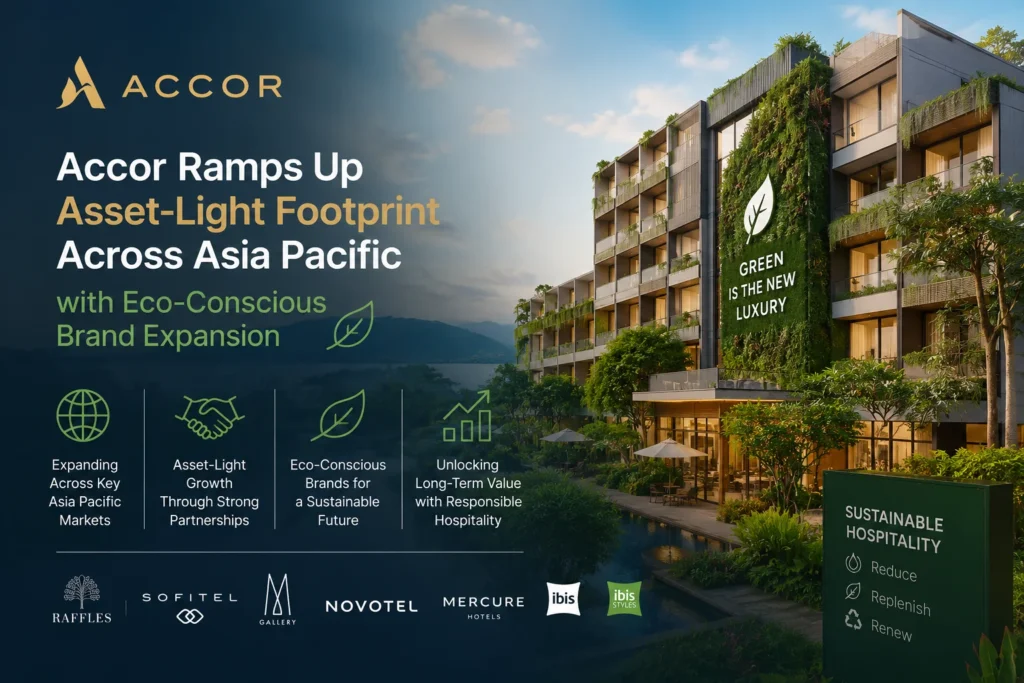
A major corporate restructuring of regional accommodation portfolios is underway following strategic development briefs from the multinational hotel group Accor. The global hospitality entity has formally announced plans to introduce its sustainable economy lifestyle brand, Greet, to the Asia Pacific market.
The strategic rollout represents a deliberate push into regional value-based leisure sectors, expanding on the brand’s established operational framework in Western Europe. Positioned as a select-service conversion brand, Greet prioritizes circular economy design principles by utilizing upcycled furniture, repurposed structural materials, and locally sourced food supply lines to reduce overall environmental impact.
Accelerated Scaling via Franchise Architecture
The expansion plan aligns with an unprecedented increase in third-party operational agreements handled by the group’s regional headquarters. Statistical reports published during the recent Accor Pacific Franchise Conference in Sydney verify that Australia and New Zealand now represent the company’s largest and fastest-growing franchise network globally, recently surpassing 150 operating hotels.
This growing pipeline reflects shifting sentiment among independent hotel asset owners, who are increasingly moving away from traditional managed platforms in favor of flexible, direct-owner operating systems. According to data from national tourism bureaus, roughly 50 percent of existing hotels in Australia and 70 percent in New Zealand remain unbranded.
This environment creates a significant market opportunity for capital-light hospitality concepts that offer immediate access to international distribution platforms. Global brand backing gives independent owners the ability to protect their asset’s local identity while utilizing a massive global reservation network to stabilize room revenues and capture recurring business from loyalty program members.
European Performance Targets and Conversion Ease
While the final geographic destinations for the inaugural Asian properties remain under strategic review, the commercial template relies heavily on the brand’s rapid deployment across key European hubs. The brand’s development pipeline is showing significant progress, highlighted by recent openings such as Greet Potsdam and upcoming mid-year projects including Greet Alicante Centro, Greet Augsburg, Greet Halle, and Greet Mettmann.
From an engineering perspective, the brand’s core design guidelines are structured to ensure quick, cost-effective conversions of pre-existing buildings. The administrative requirements focus primarily on baseline fire, life, and safety compliances rather than forcing owners to execute rigid, expensive structural re-designs.
To maintain the brand’s core identity, each property must incorporate specific operational elements, which include:
Upcycled Accommodations: Ensuring every guest room features at least three certified repurposed decor items or vintage furniture pieces.
Communal Dining Hubs: Incorporating a central upcycled table d’hôte to encourage informal social interaction among travelers.
High-Capacity Family Units: Designing a mandatory 20 percent of total room inventory to comfortably house groups of four to six guests.
Zero Food-Waste Commitments: Utilizing localized, short food supply lines and converting breakfast leftovers into specialty day-time snacks.
Broader Network Diversification Across the Continent
The upcoming launch of Greet complements a broader capital investment program aimed at diversifying Accor’s footprint of over 420 properties across the Pacific region. The group continues to build out the pipelines of past midscale acquisitions, including the regional hotel groups Peppers and Mantra. This initiative is supported by widespread renovations, such as the complete 277-room refurbishment of the Mantra Melbourne Airport and the opening of the Mercure La Trobe in Melbourne’s academic corridor.
Simultaneously, the group is expanding its lifestyle and luxury footprints. This includes the rollout of Hyde Perth, an upscale 120-room property managed by its specialized Ennismore division, alongside a large-scale resort development in the South Pacific.
The upcoming Vatu Talei by Sofitel on Denarau Island in Fiji will feature 127 luxury rooms situated across a 10-acre coastal plot. By combining entry-level sustainable concepts like Greet with premium luxury resorts, the hospitality group is building a balanced regional network designed to capture a wide range of traveler demographics, keeping its market share secure as global travel patterns continue to evolve.
For more travel news like this, keep reading Global Travel Wire