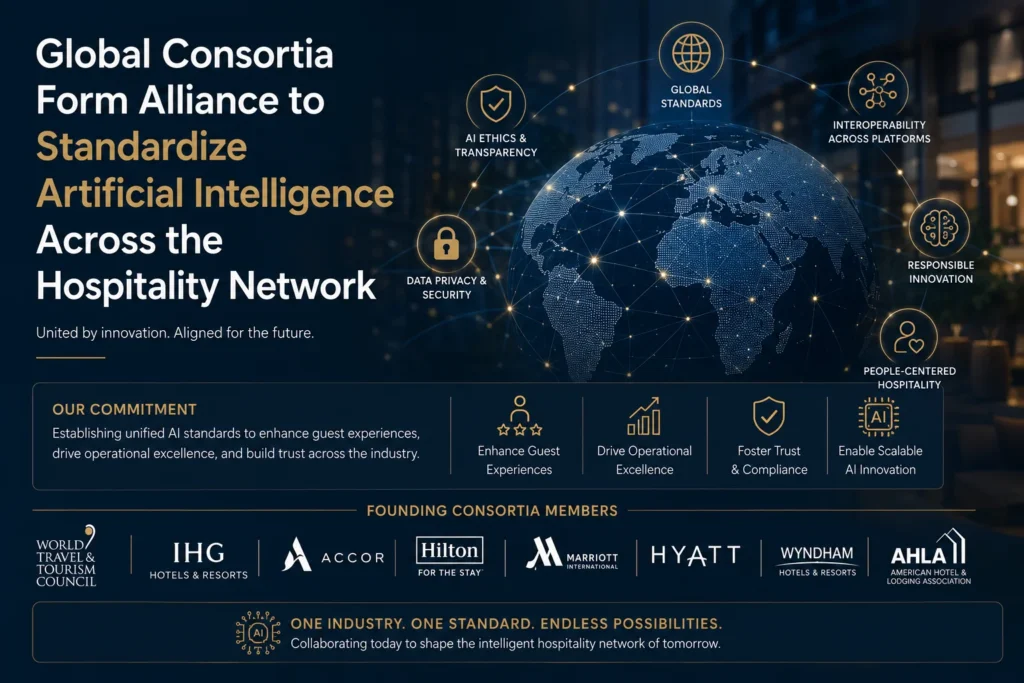
An official press release issued from the international headquarters of Hospitality Financial and Technology Professionals (HFTP) in Austin, Texas, has introduced a massive collaborative alliance to govern digital guest experiences. Ten prominent global hospitality associations have officially integrated their resources into the HFTP AI Collective, a nonprofit organizational initiative tasked with accelerating the safe, ethical, and uniform deployment of artificial intelligence across the global lodging ecosystem.
The rapid consolidation of these major advocacy groups addresses an industry-wide need for coherent technical governance. As property management systems, automated booking engines, and algorithmic guest-relations platforms become deeply embedded in regional resort management, the unified council will collaborate to publish nonproprietary hospitality technology standards that protect consumer data privacy and streamline operational efficiency.
Broad Sector Diversity Achieved Through Alliance Scaling
The newly expanded collective introduces deep geographic reach and multi-layered industry representation to the technology framework. By including bodies that govern hotel ownership, academic research, luxury travel, and regional club management, the alliance establishes a balanced foundation to evaluate emerging algorithmic software.
The ten newly inducted associations, arranged by their functional divisions, include:
Property Ownership and Core Advocacy: The American Hotel and Lodging Association (AHLA) and the Asian American Hotel Owners Association (AAHOA).
Niche and Regional Tourism Development: The Boutique Luxury Lodging Association (BLLA) and the Caribbean Hotel and Tourism Association (CHTA).
Specialized Facility and Club Operations: The Club Management Association of America (CMAA) and the Hospitality Sales and Marketing Association International (HSMAI).
Technical Integration and Systems Engineering: Hospitality Technology Next Generation (HTNG) and the Japan Hospitality Technology Association (JHTA).
Academic Innovation and Institutional Research: The International Council on Hotel, Restaurant, and Institutional Education (ICHRIE) and the International Hospitality Information Technology Association (iHITA).
In official ministerial statements accompanying the rollout, HFTP Chief Executive Officer Frank Wolfe stated that the expansion represents a critical milestone toward building a single, unified development pathway. The cooperative structure ensures that independent boutique operators, high-capacity resort networks, and academic researchers possess equal access to verified deployment strategies, allowing smaller destination properties to upgrade their systems without facing cost-prohibitive vendor barriers.
Operational Milestones and the Technical Strategy
Aviation and resort tech experts note that rather than building a single proprietary software product, the AI Collective will operate as a standard-setting body. For local tourism operators, this collaborative framework will directly influence future procurement guidelines, request-for-proposal (RFP) evaluations, and property-level data schemas.
The collective’s immediate roadmap focuses on developing shared vendor interoperability checklists and common API architectures. These tools are designed to prevent structural integration failures when properties link AI features to legacy infrastructure.
Additionally, the inclusion of educational bodies like ICHRIE ensures that upcoming work papers will prioritize workforce reskilling. This guarantees that front-desk personnel, reservation specialists, and property managers are properly trained to manage automated guest communications responsibly.
Practical Safeguards for Destination Technology Procurement
To ensure that independent resort groups and regional tourism boards maintain clear oversight as automation expands, the collective’s advisory boards recommend that hotel leadership teams apply a specific three-part assessment framework before activating any automated guest interface:
Identify the Human Element: Clearly define the specific employee decision that the software is meant to support, rather than fully replace, to protect service quality.
Establish Operational Safeguards: Create redundant response protocols to handle booking or communication errors if an automated script generates inaccurate itinerary data.
Confirm Internal Accountability: Explicitly assign on-property personnel to remain legally and operationally responsible for data compliance and guest problem resolution.
The upcoming general assembly of the newly formatted alliance is scheduled to convene during the unified technology expos in mid-June, where working committees will deliver initial framework papers on cross-border data privacy. By establishing these nonproprietary baselines, the HFTP AI Collective aims to stabilize the global travel ecosystem, ensuring that as international properties deploy automation, they remain fully anchored in human accountability and consumer data safety.
For more travel news like this, keep reading Global Travel Wire