The intersection of artificial intelligence and global hospitality is transforming how destinations welcome international travelers. From automated check-in desks to AI-driven concierge services, futuristic hospitality technology continues to draw tech-savvy visitors worldwide. However, recent real-world evaluations reveal that while automated companions excel in controlled environments, integrating autonomous systems seamlessly into everyday service roles remains an ongoing challenge.
According to official public briefings from the Beijing Municipal People’s Government and event organizers, the second edition of the World Humanoid Robot Games expanded well beyond athletic track and field exhibitions. Alongside athletic competitions, official schedules featured 21 scenario-based operational contests designed to test autonomous machinery in actual service settings, including modern hotels, residential homes, logistics hubs, and industrial facilities.
Testing Service Automation in Hospitality and Household Travel Settings
The rapid expansion of automated service technology has made smart travel experiences a focal point for modern destination management. As public venues and destination resorts explore autonomous staff to handle hospitality tasks, real-world trials provide critical data on feasibility and visitor safety.
In household and residential service trials, 38 international teams put their autonomous platforms to the test across domestic chore sequences. Machines were instructed to organize living spaces, fold bedroom garments, and execute laundry workflows. To replicate unpredictable, real-world guest environments, organizers introduced unscheduled interruptions, such as an unexpected parcel delivery. Upon receiving a natural voice command, platforms were required to pause ongoing tasks, retrieve the package, and resume their duties.
Official scoring guidelines strictly penalized operational errors. Points were deducted for structural collisions, dropped items, or crossing designated spatial boundaries. Furthermore, any instance requiring manual human intervention resulted in the attempt being downgraded to remote-control status, cutting the overall performance weight in half.
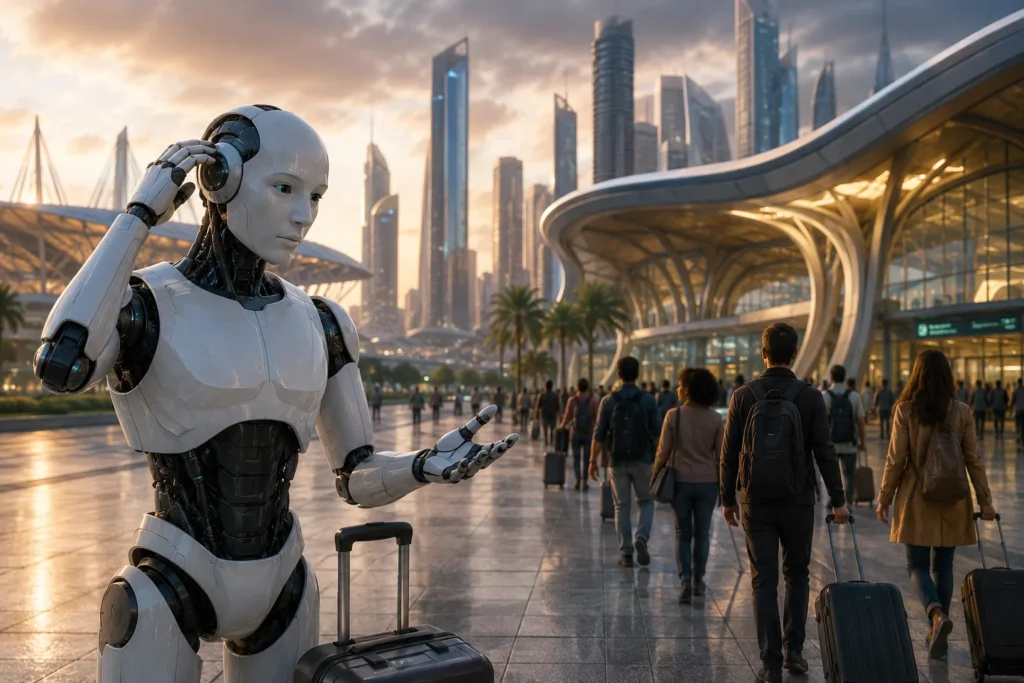
Hospitality service automation was put to a direct test in a simulated hotel environment. Within a strict 30-minute window, platforms were tasked with navigating corridors to wheel guest luggage directly to designated guest rooms, restocking essential guest amenities—such as fresh towels, slippers, and bottled water—and clearing dirty linens while remaking room bedding. Demonstrating advanced mobility and precise spatial awareness, the Shenzhen AgiBot team secured the Gold Medal utilizing its Spirit G2 platform.
Disaster Response and Outdoor Environmental Challenges
Beyond indoor hospitality, global tourism infrastructure relies heavily on robust emergency response and public safety systems. High-density tourist sites, national parks, and large-scale convention centers require reliable disaster management solutions. To assess autonomous capability in hazardous situations, official trial final matches were held at an active fire brigade station to evaluate operational performance under unpredictable outdoor conditions.
Participating units were given a 30-minute window to complete a complex three-step response sequence without direct physical human intervention. This outdoor trial highlighted a significant performance gap between sterile laboratory setups and unscripted outdoor travel environments. Natural direct sunlight, dynamic smoke plumes, and uneven outdoor ground surfaces repeatedly disrupted optical vision sensors and compromised walking balance. Out of 12 competing teams, only 3 successfully completed the entire operational task chain within the allotted time frame, with the AgiBot Spirit G2 platform again claiming top honors.
Other participating entries, including the UniX AI team, successfully finished the response course, though their movement was noticeably slower than human emergency personnel. Their unit required multiple attempts simply to align its mechanical grippers with an extinguisher’s squeeze trigger. Despite these operational delays, official organizers noted that gathering failure data under harsh, unscripted conditions remains the essential primary goal for upgrading autonomous emergency response software.
The Technological Bottleneck for Future Smart Destinations
Addressing the technical boundaries exposed by these public trials, industry leadership highlighted that limited generalization capability remains the single largest bottleneck facing the global humanoid robotics sector. In controlled indoor settings where artificial intelligence models are trained on comprehensive datasets, task success rates routinely approach 100 percent. However, operational performance can decline sharply the moment the target object or surrounding physical environment undergoes unexpected changes.
Industry experts project that a major milestone in embodied intelligence will occur when an autonomous platform can be introduced to an unfamiliar physical location and successfully complete approximately 80 percent of everyday routine tasks through simple voice or text commands. Current technical trajectories suggest such an operational breakthrough could emerge within two to three years, or within five to ten years at the absolute latest.
For the travel and hospitality sectors, these rigorous public trials provide a realistic roadmap. While full service automation across hotels, airports, and public attractions will require further refinement, continuous testing under real-world conditions ensures that future smart tourism innovations will ultimately deliver safer, more efficient, and truly seamless visitor experiences worldwide.
For more travel news like this, keep reading Global Travel Wire