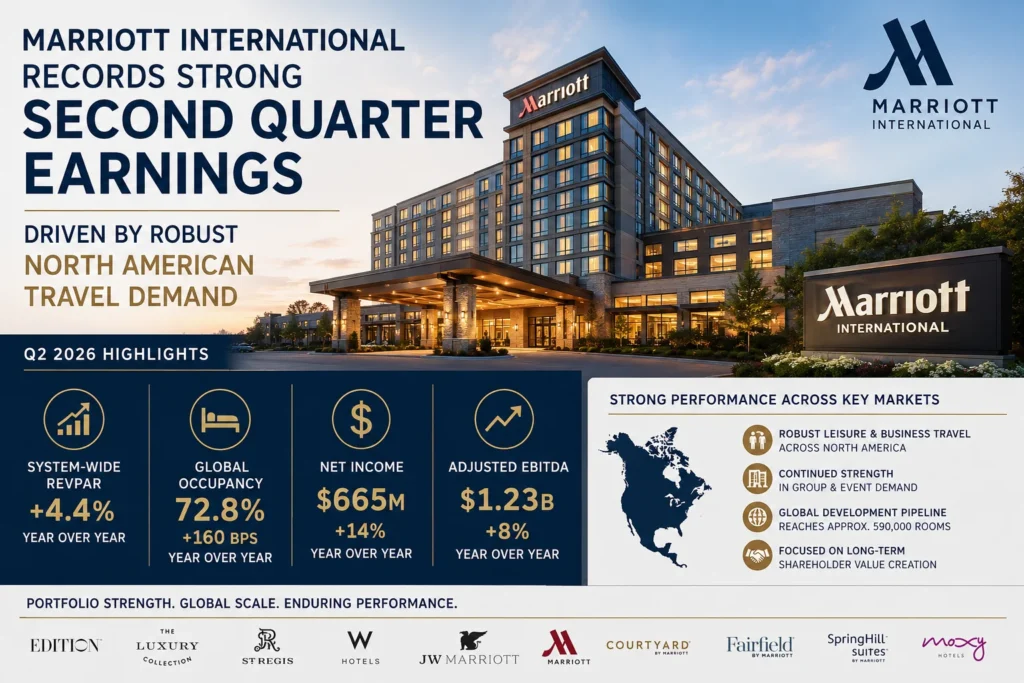
Global lodging leader Marriott International has reported positive second-quarter financial performance, bolstered by expanding brand presence, disciplined development momentum, and sustained travel demand. Worldwide revenue per available room—a key operational metric measuring lodging performance—increased 3.4 percent compared to the same period in the previous year.
Driven by steady leisure tourism and corporate travel across domestic markets, North American hotel operations demonstrated notable strength. Despite regional headwinds in select international travel corridors, the company’s strong operational foundation and loyalty network have enabled management to raise its full-year global outlook.
North American Lodging Demand Surges as International Markets Diverge
The company’s performance during the quarter highlights a distinct geographic divergence in travel trends. Properties in the United States and Canada generated a robust 5.0 percent increase in revenue per available room. This domestic expansion was supported by solid average daily rates and high occupancy across luxury, premium, and select-service lodging categories.
Conversely, international performance experienced a slight contraction of 0.5 percent overall. While European destinations recorded positive room revenue growth and Asia-Pacific markets expanded by over 5 percent due to intra-regional travel, geopolitical tensions in the Middle East resulted in a localized operational decline.
In contrast, Greater China demonstrated renewed momentum, recording a room revenue increase exceeding 3 percent. Performance in key regional tourism markets—including Hong Kong, Taiwan, and Hainan—was particularly strong across luxury resort and business properties.
Record Global Development Pipeline and System Growth
Expansion across international markets remains a primary catalyst for long-term growth. During the quarter, the global hotel operator added approximately 17,900 net rooms to its portfolio, with international destinations accounting for 11,000 of these additions. The company’s active global lodging system now encompasses over 10,000 properties, representing nearly 1.814 million guest rooms worldwide.
Development activity reached milestone levels, bringing the global hotel development pipeline to a record total of nearly 4,200 properties, representing approximately 629,000 rooms. Demonstrating strong capital commitment from real estate owners and developers, roughly 44 percent of these pipeline rooms are currently under active construction.
Independent property conversions continue to serve as a high-growth vehicle for global network expansion. Hotel conversions represented over one-third of new franchise and management contract signings, as well as 40 percent of all property openings during the first half of the year. This strategy allows existing hotel owners to rapidly integrate into global reservation channels and international brand distribution platforms.
Loyalty Engagement and Financial Performance Highlights
The Marriott Bonvoy travel loyalty platform reached a significant milestone, expanding its global membership base to over 295 million registered members. The platform continues to drive direct consumer bookings, reduce customer acquisition costs, and foster repeat travel across the company’s diverse multi-brand portfolio.
To support long-term loyalty engagement, the company executed extended agreements for its co-branded credit card programs with major financial partners, including JPMorgan Chase and American Express. These financial agreements enhance fee revenue streams while providing expanded travel perks and reward redemption options for cardholders worldwide.
For the quarter, total franchise and base management fees rose 14 percent year-over-year to $1.366 billion, propelled by higher co-brand credit card fees, net room additions, and improved overall room revenue. Incentive management fees reached $212 million, with managed international hotels contributing more than half of total incentive earnings. Reported net income for the quarter stood at $766 million, with Adjusted EBITDA increasing 13 percent to reach $1.592 billion.
Operational Outlook and Global Tourism Perspective
Capital return strategy remains central to corporate allocation, with $1.1 billion returned to shareholders via common stock repurchases during the second quarter alone. Year-to-date capital returns through share repurchases and cash dividends have totaled approximately $2.6 billion.
Executive leadership expressed strong confidence in the endurance of global travel demand and the strength of its core lodging brands. Based on favorable broad-based demand forecasts, full-year expectations for worldwide revenue per available room growth have been revised upward to between 3.0 and 3.5 percent.
As global travelers continue seeking high-quality accommodation experiences across leisure, business, and group event sectors, disciplined capacity growth and digital platform expansion are projected to keep the lodging giant well-positioned within the evolving international tourism economy.
For more travel news like this, keep reading Global Travel Wire