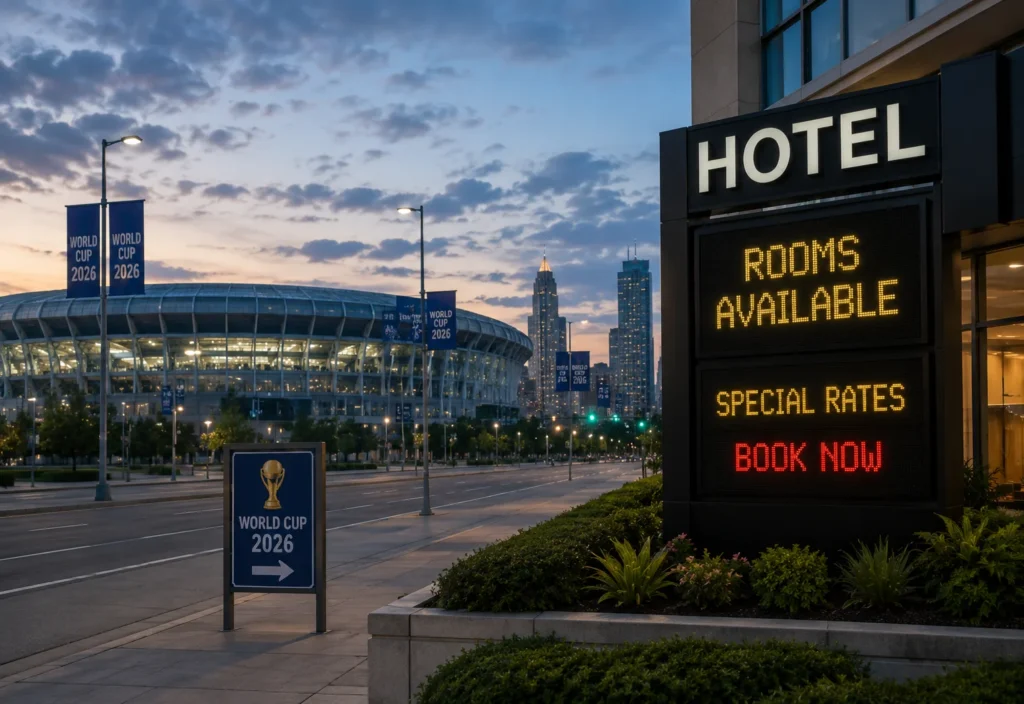
The highly anticipated summer soccer tournament in North America is experiencing an unexpected shift in its accommodation landscape. While initial hospitality forecasts pointed toward a completely sold-out lodging market with sky-high pricing, recent regional booking data reveals a much softer-than-projected reservation rate across key metropolitan zones. This newly emerging trend is changing the dynamic of the summer travel season, offering both domestic sports fans and general leisure travelers unexpected leverage, enhanced booking flexibility, and more competitive overnight rates in major host cities.
According to the official Hotel Outlook Report compiled by the American Hotel & Lodging Association (AHLA), approximately 80% of surveyed hoteliers in host markets report that advanced room bookings are currently tracking below their initial high-volume forecasts. Rather than facing a severe inventory crunch, many metropolitan destinations still boast significant open room capacity, prompting hospitality operators to recalibrate their revenue management strategies.
Global Visitor Forecasts Adjusted as Travel Realities Stabilize
A major driver behind the calmer lodging market is the downward revision of international traveler projections. Initial multi-year economic impact models were built on the assumption of massive, sustained global arrivals. However, updated analysis from Tourism Economics has moderated the international visitor projection to approximately 1.24 million global arrivals for the tournament.
Several factors have contributed to this recalibration of overseas demand:
Geopolitical and Visa Barriers: Across surveyed host markets, approximately 65% to 70% of hoteliers identify international visa processing wait times and broader global economic dynamics as key constraints on incoming overseas travel.
Aviation Costs: High international flight prices have caused some long-haul travelers to reconsider multi-city itineraries.
Exchange Rates: Changing currency valuations have made extended stays in North American metropolitan areas more expensive for certain international visitor segments.
Additionally, the initial demand signals were somewhat inflated by large-scale room blocks. The AHLA report highlights that overcommitted room allocations reserved early by organizers created an artificial scarcity. As these blocks have been released back into the general public inventory, available supply has risen, providing travelers with direct access to rooms that were previously locked.
Hospitality Industry Adapts with Flexible Policies and Strategic Pricing
To maintain healthy occupancy levels on non-match days, property managers and hotel groups are moving away from rigid booking requirements. During the initial planning phases, many hotels enforced strict multi-night minimum stays and non-refundable booking terms. Today, however, many operators have relaxed these rules.
Domestic travel patterns have also normalized. Many traditional, non-sporting summer travelers are actively bypassing major host cities to avoid predicted crowds and localized inflation. To offset the loss of standard summer leisure traffic, hotels are working to appeal directly to regional drive-in visitors and last-minute domestic match attendees by offering more palatable pricing and shorter-term stay options.
While room rates still experience noticeable spikes on actual match days—especially near major stadium transit corridors—the periods between matches are seeing much softer demand. This pattern is resulting in a modest projected national revenue per available room (RevPAR) increase of just 1.7% over the tournament months, a far more conservative gain than initially predicted.
Regional Projections and Infrastructure Focus Across Key Host Markets
The economic impact of the tournament remains highly concentrated around key matches and high-profile knockout fixtures. Regional host committees and municipal tourism boards have published localized projections detailing where economic activity is expected to be strongest:
| Host Metropolitan Area | Projected Economic Impact | Key Fixture & Date | Primary Infrastructure Focus |
| New York / New Jersey | $3.3 Billion | Tournament Final — July 19, 2026 | Airport transit capacity expansions |
| Miami | $1.5 Billion | Quarter-final — July 11, 2026 | Port and regional rail shuttle upgrades |
| Houston | $1.5 Billion | Group matches | Hub airport terminal adjustments |
| Boston | $1.1 Billion | Quarter-final — July 11, 2026 | Intercity rail corridor scheduling |
| Seattle | $929 Million | Group matches | Light rail transit extensions |
| Philadelphia | $770 Million | Group matches | Regional rail network coordination |
| Kansas City | $653 Million | Quarter-final — July 10, 2026 | Local bus corridor enhancements |
| Los Angeles | $594 Million | Quarter-final — July 9, 2026 | Airport connection shuttles |
| Atlanta | $503 Million | Semi-final — July 15, 2026 | Airport terminal transit upgrades |
| San Francisco Bay Area | $480 to $630 Million | Group matches | Regional transit interconnections |
| Dallas | $400 Million | Semi-final — July 14, 2026 | Highway and parking corridor setups |
Practical Booking Recommendations for Summer Travelers
With more options open to consumers, travelers planning to visit host cities during the summer tournament window can optimize their travel itineraries by utilizing several official administrative and transit resources:
Review Visa Status Early: International visitors requiring entry permissions should consult the U.S. Department of State portal to monitor real-time visa wait times and appointment availability.
Coordinate with Local Transit Systems: To bypass stadium parking fees and congestion, travelers are encouraged to utilize updated regional rail and shuttle networks. The U.S. Department of Transportation (DOT) and local municipal transit authorities provide comprehensive maps and scheduled tournament service updates.
Prioritize Direct Bookings: Booking directly through official hotel reservation systems often grants travelers access to more flexible cancellation terms, loyalty benefits, and real-time room availability compared to third-party travel search engines.
Explore Adjacent Subregions: Staying in communities situated slightly outside the central stadium districts can yield substantial lodging savings while keeping travelers well within commuting distance via regional light rail corridors.
For more travel news like this, keep reading Global Travel Wire