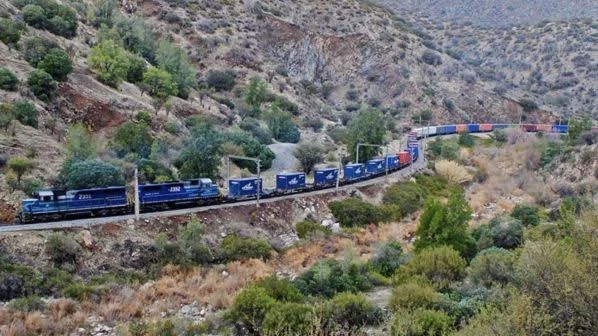
Chile has launched a major intermodal freight experiment connecting the Metropolitan Region around Santiago with the Biobío Region, combining electric trucks and rail across a journey exceeding 500 kilometres.
The initiative is designed to test whether long-distance cargo can move more efficiently when trucks handle shorter first- and last-mile sections while trains carry freight over the longer central portion of the journey. The trial brings together public authorities, railway operators, logistics companies, researchers and cargo-generating businesses.
The project began at Agunsa’s facilities in Lampa, north of Santiago. Chile’s Minister of Public Works and Transport and Telecommunications, Louis de Grange, participated alongside EFE President Jorge Claude and Conecta Logística Executive Director Mabel Leva.
Official information from Conecta Logística confirms that the programme is intended to demonstrate that trains and trucks can work as a practical combined system for moving mass-consumption goods between central and southern Chile.
Electric trucks handle shorter road connections
Road transport remains an essential part of the new logistics model.
Sotraser is responsible for the initial and final road sections and is incorporating electric trucks from its fleet into the operation. Cargo is transported to an interchange facility before being transferred onto trains.
Agunsa manages transfers between road and rail in Santiago, while Sitrans performs corresponding operations in the Biobío Region.
The structure illustrates the central idea behind intermodal logistics.
Rather than attempting to eliminate trucks, the model assigns them to shorter and more flexible movements. Rail then handles the longer-distance section where trains can potentially transport larger volumes more efficiently.
This could reduce dependence on heavy trucks travelling hundreds of kilometres on major highways.
Fepasa trains carry freight towards Biobío
The railway section is being operated by Fepasa, with freight moving towards Talcahuano in the Biobío Region.
Cargo categories being tested include beverages, food, wine, retail products, ceramics, cement and other construction materials.
Testing different commodities is important because each supply chain presents different operational requirements.
Food and beverages may require different loading, handling and timing conditions from cement or industrial materials. By testing a broad mix, the pilot can provide more useful evidence about where intermodal transport works commercially.
If the system proves reliable, lessons from the trial could support more regular freight services in the future.
GPS and telemetry measure environmental performance
Chile is treating the project as more than a demonstration journey.
The Advanced Centre for Transportation, Logistics and Economic Competitiveness will monitor the operation using GPS information and telemetry.
Researchers will assess operational performance while also examining potential reductions in emissions.
This data will be important because the environmental advantages of changing freight modes need to be demonstrated under real operating conditions.
Combining electric trucks with rail could reduce the environmental footprint of long-distance shipments, but the pilot will help determine the scale of those benefits.
It will also provide information on reliability, energy consumption and practical logistics performance.
Project builds on earlier intermodal testing
The Santiago-Biobío initiative follows earlier testing of combined road and rail freight in Chile.
A previous intermodal pilot between Santiago and Temuco took place in 2024 and transported 32,000 litres of beverages.
According to the project information, that type of operation had not taken place along the corridor for more than 15 years.
The latest experiment expands the concept to a longer and more diverse freight operation.
This gradual approach allows authorities and businesses to test systems, identify problems and collect evidence before considering larger-scale commercial deployment.
Barrancas terminal strengthens rail-port strategy
Chile is also developing new infrastructure to support greater use of railway freight.
EFE is advancing the Barrancas Intermodal Terminal at San Antonio, one of the country’s most important port locations.
The project is intended to substantially increase rail freight handling capacity linked to the Port of San Antonio.
Official transport planning documents have examined how railway connections can improve freight movement between ports and inland logistics centres.
This is particularly significant as Chile seeks to move growing cargo volumes without creating proportional increases in road congestion, highway wear and transport emissions.
A stronger rail-port connection could allow containers arriving by sea to continue inland by train rather than depending entirely on trucks.
Sustainable freight can support the visitor economy
Although the initiative is primarily focused on cargo, it also has potential implications for travel and tourism.
Hotels, restaurants, airports and tourism businesses depend on reliable supply chains for food, beverages, equipment and other goods.
Moving more long-distance freight by rail could also reduce the number of heavy vehicles on major road corridors.
That could improve road conditions for residents and travellers, particularly around large cities, ports and industrial areas where congestion can affect journey times.
A more balanced transport network can therefore support both commercial logistics and passenger mobility.
Chile develops a new freight transport model
The Santiago-Biobío trial represents a broader attempt to understand how rail, electric trucks, intermodal terminals and digital monitoring can operate as one integrated logistics chain.
Conecta Logística officially describes intermodal freight as one of its sustainability initiatives, promoting collaboration between trains and trucks as an alternative for transporting mass-consumption cargo.
The project will now provide evidence on reliability, operational efficiency and emissions performance.
If the model proves commercially viable, it could support wider adoption of intermodal freight corridors across Chile.
For the country’s transport system, the long-term opportunity is significant: rail could take on more high-volume, long-distance cargo while trucks continue providing flexible local connections.
That division could reduce emissions, strengthen port connectivity and create a more resilient logistics network while also easing pressure on road infrastructure used by residents and tourists.
For more travel news like this, keep reading Global Travel Wire