Thailand has taken a significant step toward developing a modern urban rail system in Songkhla Province after the Cabinet approved in principle the legal framework allowing the Mass Rapid Transit Authority of Thailand to advance a monorail project in Hat Yai.
The proposed system will extend for 12.54 kilometres and include 12 stations, three major interchange points and a depot and maintenance centre at Khlong Hwa. The plan is intended to strengthen public transport across one of southern Thailand’s most important commercial and tourism centres.
The Cabinet decision was made on August 5, 2026. However, the approval does not mean construction will begin immediately. Instead, it allows the draft royal decree to proceed through further legal examination while the Ministry of Transport and MRTA continue preparing the project.
For travellers, the proposed monorail could eventually create a more structured and convenient way to move between transport hubs, commercial districts, university areas and other parts of Hat Yai.
Cabinet gives project crucial legal backing
The Thai Cabinet approved in principle a draft royal decree authorising MRTA to operate rail transport in Songkhla Province.
The proposal was submitted by the Ministry of Transport and will now proceed to Thailand’s Council of State for examination.
The government has also instructed relevant ministries and agencies to consider environmental, economic and budgetary observations before the project progresses further.
This legal step is important because MRTA requires formal authority before developing urban rail systems in new provincial areas.
Songkhla would join other provinces where MRTA has been assigned a role in developing regional rail transport, including Chiang Mai, Phuket, Nakhon Ratchasima and Phitsanulok.
Monorail will cover 12.54 kilometres
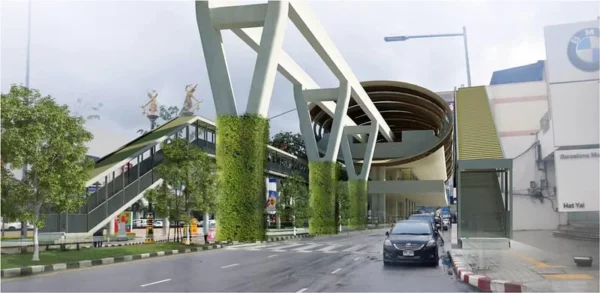
The planned Hat Yai system will use a straddle-beam monorail design.
Its alignment begins near Khlong Hwa and continues through important sections of Hat Yai before reaching the van terminal.
A total of 12 stations are included in the current design.
The project is intended to offer an alternative to road-based travel along busy urban corridors, potentially reducing dependence on private cars and other vehicles.
Elevated monorail infrastructure can also reduce direct interaction between trains and road traffic, which may help maintain more predictable journeys in heavily used areas.
For Hat Yai, where commercial, educational and tourism activity generates significant daily movement, improved public transport could become an important part of the city’s future mobility system.
Three interchange stations improve connectivity
Three stations have been identified as major transfer points: Khlong Hwa, Kho Hong and the van terminal station.
These locations are intended to help passengers move between the monorail and other forms of transport.
The project design includes passenger pick-up and drop-off areas as well as park-and-ride facilities.
Such integration is particularly important for travellers arriving from surrounding districts.
Visitors may eventually be able to leave private vehicles outside congested areas or connect from buses and vans before continuing their journeys by monorail.
Khlong Hwa will also house the system’s depot and maintenance centre, giving the location both operational and passenger functions.
Kho Hong link could support everyday travel
Kho Hong is another strategically important area along the planned route.
The district includes educational, residential and economic activity, generating regular passenger demand.
A monorail connection could provide students, workers and residents with another transport option while also making the area easier for visitors to navigate.
The project therefore extends beyond tourism.
Its primary role is to create an urban transport system serving people who live, study and work in Hat Yai.
However, tourists could become important beneficiaries because better public transport often improves the overall visitor experience.
Hat Yai tourism could gain from easier mobility
Hat Yai is one of southern Thailand’s leading commercial centres and has strong economic links with neighbouring Malaysia.
Cross-border visitors contribute to hotels, restaurants, shopping districts and tourism businesses throughout the city.
Improved urban transport could make it easier for those travellers to move between accommodation areas, commercial zones and transport terminals.
This is particularly relevant for short-stay visitors arriving from Malaysia, who often have limited time to explore the city.
A simple rail system could reduce dependence on taxis and road-based transport while making the destination easier to understand for first-time visitors.
The eventual tourism impact will depend on fares, operating hours and integration with other transport services.
Sustainable transport becomes another priority
The monorail also supports Thailand’s broader interest in sustainable urban mobility.
Growing cities face increasing pressure from traffic congestion, emissions and limited road space.
Electric urban rail can move significant numbers of passengers along fixed corridors without adding equivalent numbers of cars to city roads.
Park-and-ride facilities may strengthen that effect by allowing passengers from surrounding areas to transfer to public transport before entering the busiest parts of Hat Yai.
The overall environmental impact will still depend on passenger demand, electricity sources and construction methods.
Airport link remains a future possibility
Hat Yai International Airport is one of southern Thailand’s major transport gateways.
Better integration between urban rail and the airport could eventually improve the usefulness of Hat Yai’s wider public transport network.
However, the currently approved 12.54-kilometre alignment does not establish an airport extension as part of the initial project.
Any future airport connection would require separate planning and approvals.
For now, the confirmed project remains the 12-station monorail covered by the Cabinet-backed legal framework.
Southern Thailand moves toward modern rail mobility
The Hat Yai monorail represents an important step in the modernisation of transport infrastructure in southern Thailand.
Its combination of 12 stations, major interchanges and an integrated depot could provide Hat Yai with a new rail-based public transport backbone.
The Cabinet approval should be viewed as the beginning of a longer development process rather than confirmation of immediate construction.
Technical planning, legal reviews, environmental requirements and procurement stages still need to advance.
If completed, however, the project could improve daily mobility while supporting tourism, retail, education and stronger cross-border economic activity with Malaysia.
For travellers, the long-term benefit could be a more accessible Hat Yai where movement between transport hubs, hotels and commercial districts becomes simpler, more sustainable and less dependent on road traffic.
For more travel news like this, keep reading Global Travel Wire