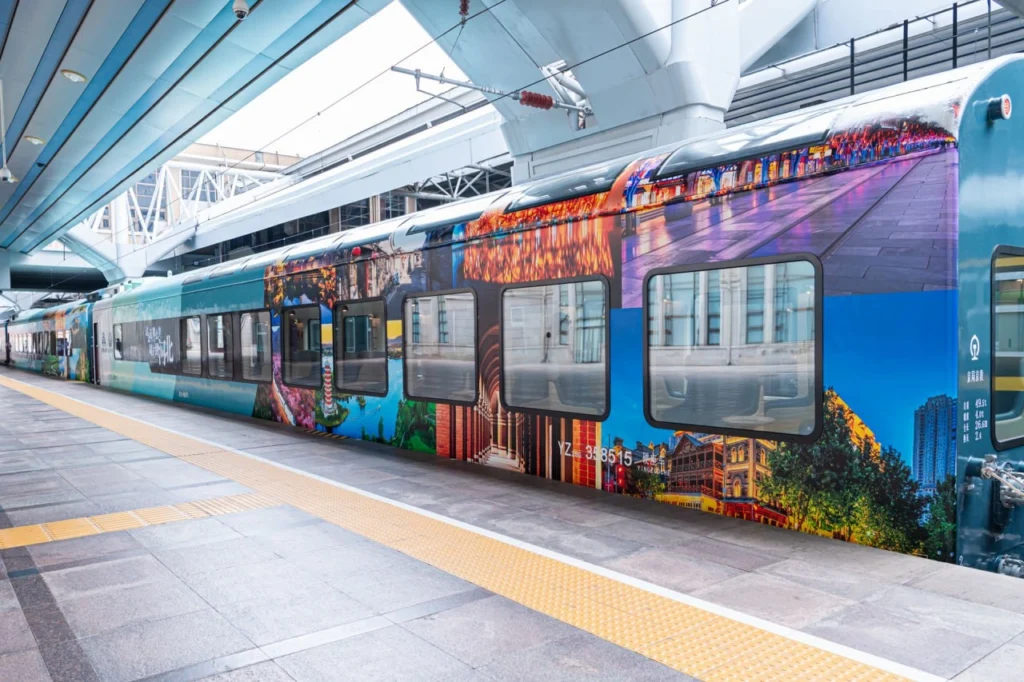
China has launched an 18-day luxury tourist train journey from Shanghai to the Xinjiang Uygur Autonomous Region, introducing a hotel-style rail experience designed for travelers seeking comfort, scenic views and immersive cultural exploration.
The Yangtze River Delta Star departed Shanghai on May 19 for its inaugural journey through northern and southern Xinjiang. The service features all soft-sleeper cabins, private bathrooms, dedicated butlers and onboard dining facilities, transforming a long-distance train journey into a premium tourism experience.
The route passes through Tianshui in Gansu Province before continuing to several major Xinjiang destinations, including Yining, Korla, Kashgar, Kuqa, Urumqi and Hami. The itinerary gives passengers an opportunity to explore landscapes ranging from mountains and grasslands to desert scenery and historic Silk Road cities without changing hotels every day.
Hotel-Style Cabins Upgrade Long-Distance Rail Travel
Unlike conventional sleeper trains, the Yangtze River Delta Star has been designed to combine rail transportation with accommodation and personalized hospitality. The train includes 12 soft-sleeper carriages, one multifunctional carriage and two dining cars.
Cabins are available in double, triple and four-person layouts, giving travelers several options based on budget, comfort and group size. Each room includes a private bathroom with separate wet and dry areas, anti-slip flooring, ventilation, lighting and safety features.
The flagship double cabin offers a large panoramic window, a wide bed with memory foam and adjustable berths that can convert into a sofa or sleeping area. Triple cabins cater to families and small groups, while four-person cabins provide a more economical choice for travelers interested in a premium journey at a lower price point.
Soundproof materials, low-noise air conditioning, smart controls and multi-mode lighting are intended to make the extended journey more comfortable. Wider corridors also improve accessibility for wheelchair users.
Panoramic Windows Turn the Train Into an Attraction
The journey is designed to make the changing scenery part of the tourism experience. Panoramic windows allow passengers to watch the landscape evolve as the train travels from eastern China toward the country’s far west.
Xinjiang is known for its dramatic geographical variety, including alpine lakes, grasslands, snow-capped mountains, desert environments and historic urban centers. For travelers, the route offers a slower and more immersive alternative to flying directly between destinations.
The train experience also reduces the need to repeatedly pack and unpack luggage. Passengers can return to the same cabin after excursions, making the itinerary particularly attractive for travelers who value convenience during a multi-day holiday.
Dining, Entertainment and Butler Service Add Comfort
The Yangtze River Delta Star includes dining areas with window-facing seats, allowing passengers to enjoy meals while watching the scenery pass by. The train also features a private dining room for small gatherings and business meetings.
A multifunctional carriage offers entertainment and relaxation spaces, including a small stage, bar area, reading zone and cultural display section. An onboard medical room staffed with professionals adds another layer of support during the long journey.
Dedicated butlers are assigned to groups of cabins around the clock. The service model combines onboard assistance, tourism guidance and local destination support, reflecting growing demand for experience-led rail holidays.
Luxury Rail Tourism Supports Xinjiang Destinations
The new service has the potential to support tourism businesses across Xinjiang by directing visitors toward a wide range of destinations within a single itinerary. Hotels, restaurants, cultural attractions, tour operators and local businesses can benefit as passengers explore cities and regional tourism sites during scheduled stops.
The route may also strengthen interest in Silk Road travel experiences. Kashgar, Kuqa, Urumqi and Hami offer different cultural and historical attractions, while Yining and Korla provide access to scenic areas and regional landscapes.
For China’s tourism industry, the service demonstrates how rail travel can become an attraction in its own right rather than simply a means of reaching a destination.
Premium Rail Journeys Gain New Appeal
Ticket prices begin at 22,999 yuan per person for four-person cabins. Triple cabins are priced at 39,999 yuan per person, while double cabins cost 56,888 yuan per person.
The launch reflects a broader shift toward high-comfort, slow-travel experiences. By combining transportation, accommodation, sightseeing and hospitality, the Yangtze River Delta Star offers travelers a distinctive way to explore China’s geographical scale and cultural diversity.
As demand grows for memorable rail journeys, the Shanghai-to-Xinjiang service could become an important showcase for the future of luxury train tourism in China.