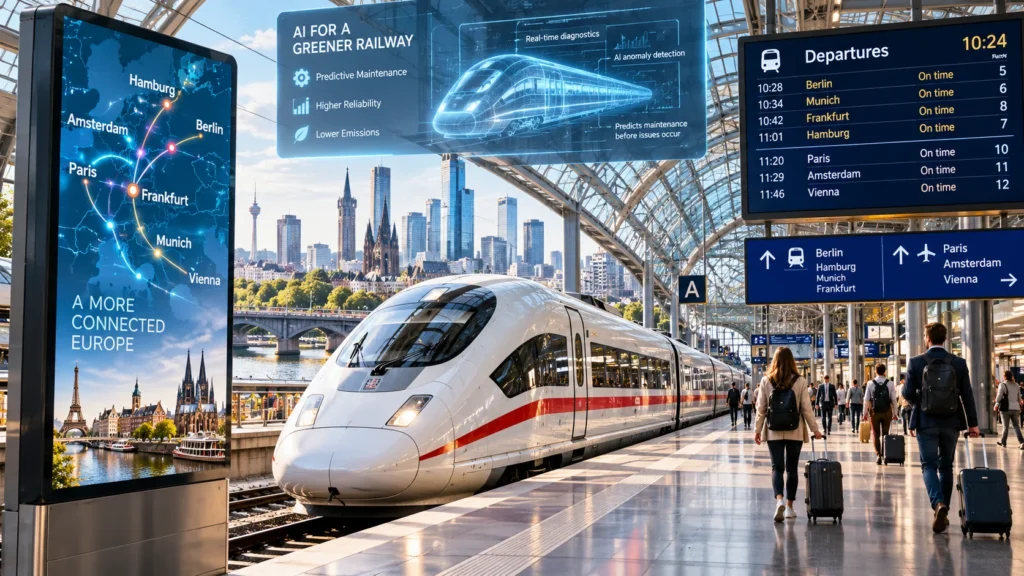
France has joined Germany, Belgium, Italy, the Netherlands, and Spain in a broader expansion of high-speed rail connectivity that is reshaping travel patterns and regional mobility across Europe. The latest progress surrounding the Trans-European Transport Network (TEN-T) signals a significant transformation in transportation planning as governments increasingly prioritize sustainable mobility, stronger regional economies, and alternatives to short-haul air travel.
The expansion reflects a wider European strategy to strengthen transport integration through faster cross-border connections and improved access to cities outside traditional capital regions. Through investments supported by the Connecting Europe Facility and coordinated infrastructure planning, cities such as Lyon, Leipzig, Ghent, Bologna, Utrecht, and Córdoba are emerging as powerful transportation hubs capable of supporting economic growth, tourism development, and regional accessibility.
The shift highlights an evolving model where high-speed rail no longer focuses solely on linking major capitals. Instead, emphasis is increasingly being placed on connecting secondary cities and creating balanced regional development.
Two-Hour Travel Windows Transform Regional Access
A key element driving the latest strategy is the growing importance of the 120-minute travel threshold.
Across Europe, rail planners increasingly view two-hour connections as a benchmark capable of influencing commuting patterns, business travel, tourism activity, and investment decisions.
Shorter journey times allow travelers to move efficiently between urban regions without relying on domestic air routes or lengthy highway journeys.
The result is a transportation model that creates broader economic opportunities beyond major metropolitan centers.
This strategy is already changing how cities position themselves within national and international transportation networks.
France Strengthens Lyon’s Position
France’s contribution to the expansion centers on Lyon, one of the country’s most important economic and transportation centers.
Improved high-speed connectivity between Paris and Lyon has reinforced the city’s position as a major intermodal hub and strengthened access throughout the Auvergne-Rhône-Alpes region.
As a gateway linking northern and southern Europe, Lyon increasingly serves as a strategic connection point for passengers and businesses operating across multiple regions.
Improved accessibility also strengthens tourism opportunities by allowing visitors to move more efficiently between cities and regional destinations.
Germany, Belgium and Italy Build Strategic Hubs
Germany continues to strengthen high-speed rail infrastructure through projects that improve links between Berlin and Leipzig, supporting the city’s growing role in logistics and regional commerce.
Leipzig has increasingly benefited from stronger transportation access that reduces dependence on road travel and improves connectivity across major economic corridors.
Belgium is also advancing mobility goals through Ghent, where integrated transportation systems are supporting wider sustainable travel objectives.
Beyond rail infrastructure itself, the city has become an example of multimodal planning that combines rail services with urban transportation systems.
Tourism authorities have also observed visitor movement shifting beyond traditional gateway cities, helping distribute tourism demand more evenly.
In Italy, Bologna continues strengthening its position as a critical transport junction.
The city’s strategic location allows it to function as a central point connecting northern and southern routes while supporting wider passenger flows across the country’s rail network.
Netherlands and Spain Advance Integrated Travel Models
The Netherlands continues emphasizing transportation efficiency through Utrecht, where high-frequency rail connections are supporting broader sustainable mobility goals.
The city has emerged as a major transportation hub integrating rail operations with urban transit and active mobility infrastructure.
Its transportation strategy reflects changing priorities focused on reducing dependency on private vehicles while strengthening public transport accessibility.
Spain is similarly expanding high-speed rail influence through Córdoba, enhancing accessibility to cultural and heritage destinations while supporting regional economic growth.
The improved connections provide travelers with easier access to destinations outside major metropolitan areas and encourage year-round tourism activity.
High-Speed Rail Shapes Sustainable Travel Future
Beyond convenience and travel times, the broader expansion carries significant environmental and economic implications.
Rail transportation increasingly forms a central component of European sustainability strategies because of its ability to reduce emissions while accommodating growing passenger demand.
Improved rail infrastructure also creates opportunities for tourism growth, regional investment, and labor mobility across interconnected regions.
The implementation of common technologies and integrated traffic management systems further supports seamless travel across national borders.
As Europe continues expanding transportation networks under the TEN-T framework, the latest developments involving France, Germany, Belgium, Italy, the Netherlands, and Spain demonstrate how high-speed rail is becoming a defining force in shaping the future of mobility.
The transformation extends beyond infrastructure itself. It represents a wider shift toward a more connected, balanced, and sustainable travel ecosystem designed to redefine how people move across Europe in the years ahead.
For more travel news like this, keep reading Global Travel Wire