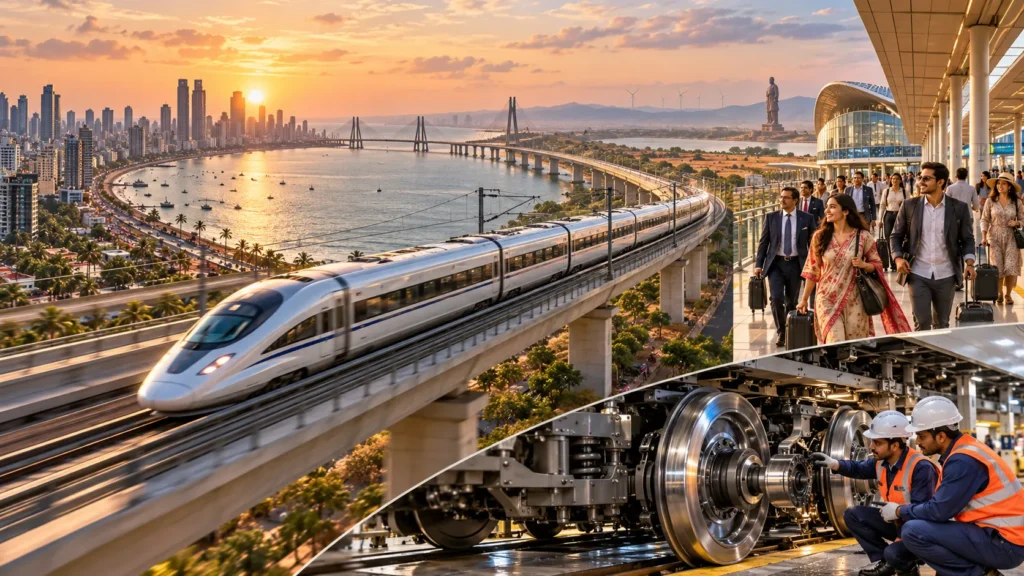
The landscape of Indian passenger mobility and regional visitor economies is approaching a transformative milestone as domestic high-speed railway infrastructure advances toward commercial realization. Official transport planning bodies and national tourism directorates have consistently positioned modern, high-velocity overland connectivity as an essential catalyst for intercity leisure exploration, business tourism, and heritage travel. A foundational technical achievement within this modernisation drive is the integration of specialized high-speed wheelset technologies, supplied by leading European railway engineering specialist Bonatrans, into the forthcoming B28 bullet trainsets designed for the landmark Mumbai–Ahmedabad High-Speed Rail corridor.
By drastically reducing transit times between western India’s primary commercial capitals, the arrival of modern bullet train travel is poised to redefine domestic holiday patterns. Historically reliant on conventional trunk rail lines or regional aviation corridors, business travelers, cultural explorers, and weekend vacationers will soon access direct, sustainable overland links connecting the financial heart of Maharashtra with Gujarat’s leading heritage, culinary, and commercial centers.
Engineering Foundations for Modern Passenger Corridors
The implementation of dedicated high-speed services demands rigorous engineering standards designed to withstand intensive daily operation, extreme climatic variations, and rapid sustained velocities. To equip the B28 high-speed trainsets, which feature an operating design speed of two hundred and eighty kilometers per hour, European manufacturer Bonatrans has introduced custom-engineered wheelsets engineered for structural reliability, weight reduction, and low lifecycle maintenance costs.
The B28 program represents a defining achievement for domestic manufacturing under national development frameworks, constructed through an engineering consortium uniting Bharat Earth Movers Limited and Medha Servo Drives. By incorporating specialized bogie components and high-integrity wheelsets, the rolling stock is configured to deliver smooth ride dynamics, lower acoustic impact, and elevated passenger comfort at top speeds.
This engagement builds on a well-established operating record within India’s broader passenger transit infrastructure. Urban rapid transit networks across major metropolitan tourism centers, including Delhi, Bengaluru, Hyderabad, Ahmedabad, Jaipur, and Kochi, have long utilized advanced wheelset assemblies to ferry millions of daily commuters and sightseers. Extending this engineering expertise to dedicated high-speed passenger lines provides a solid technical framework for safe, high-frequency, and dependable regional travel.
Unlocking Tourism Corridors Across Western India
The Mumbai–Ahmedabad High-Speed Rail corridor traverses one of the most culturally vibrant and commercially active belts in the country. Tourism ministries and regional destination management boards highlight that slashing the journey time between Mumbai and Ahmedabad from more than six hours to under three hours will dramatically stimulate visitor dispersal into secondary destinations along the alignment.
Intermediate stations planned across southern and central Gujarat, including Vapi, Surat, Bharuch, and Vadodara, will emerge as easily accessible weekend getaway destinations for travelers originating in Mumbai and Pune. Coastal leisure hubs such as Daman, textile and culinary hubs in Surat, and cultural marvels such as the UNESCO World Heritage-listed historic core of Ahmedabad and the Champaner-Pavagadh Archaeological Park near Vadodara will benefit directly from rapid, same-day rail accessibility.
Furthermore, international travelers arriving via Mumbai’s international aviation gateways can seamlessly transition to high-speed rail corridors, touring western India’s architectural landmarks, coastal sanctuaries, and handicraft circuits without relying on regional flights. This intermodal connectivity directly supports national tourism targets by broadening the geographical distribution of visitor spending across local hospitality providers, artisanal craft markets, and regional dining establishments.
Fostering Sustainable Low-Carbon Travel Networks
As environmental stewardship and decarbonization become central criteria for global leisure travelers, modern electrified rail transit stands out as an ecologically sustainable alternative to short-haul aviation and intercity highway transit. Official environmental assessments emphasize that high-speed electric train corridors produce significantly lower carbon emissions per passenger-kilometer compared to fossil-fuel-powered modes of transport.
The lightweight design, energy-optimized materials, and aerodynamic profiles incorporated into the B28 trainsets contribute directly to energy conservation across high-frequency operations. By shifting passenger volumes away from congested multi-lane highways and regional flight corridors, high-speed rail establishes an eco-friendly transport spine across western India, directly supporting national sustainability pledges and sustainable destination development.
The integration of advanced regenerative braking systems, minimal trackside noise footprints, and continuous automated speed monitoring ensures that high-speed rail operations respect surrounding natural ecosystems and rural communities adjacent to the rail right-of-way.
A New Benchmark for Indian Railway Tourism
The ongoing transformation of Indian Railways reflects a comprehensive modernization program designed to elevate public passenger standards across the subcontinent. From the expansion of indigenous semi-high-speed express services to the commissioning of dedicated high-speed corridors, modern rolling stock engineering is positioning rail as a preferred, stylish, and comfortable choice for leisure travel.
Through strategic industrial collaborations uniting international rail engineering specialists with domestic manufacturing consortia, the nation is establishing the technical capacity required to operate an extensive network of modern passenger corridors. As track construction, electrical substations, and dedicated passenger terminals near completion across Maharashtra and Gujarat, high-speed rail tourism is set to welcome millions of domestic and global explorers, ushering in an era of rapid, reliable, and scenic overland exploration.
For more travel news like this, keep reading Global Travel Wire