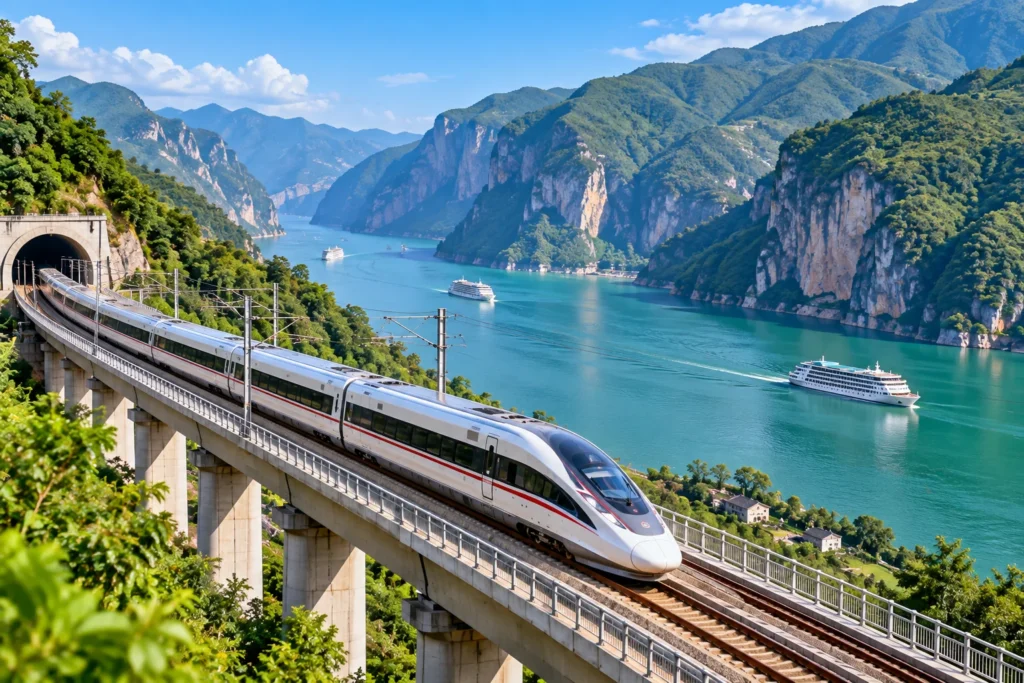
China Railway Wuhan Bureau Group announced the official opening of the Yichang-Xingshan high-speed railway line in Hubei province. Traversing the mountainous terrain of Central China, the new rail link directly connects the Daba Mountain region with two major national transport corridors: the Shanghai-Chongqing-Chengdu high-speed railway line and the Zhengzhou-Chongqing high-speed railway line.
The 101-kilometer railway operates at a maximum design speed of 350 kilometers per hour. By connecting regional travel hubs, the line slashes local transit times—cutting travel between Xingshan and Yichang from two hours to approximately 20 minutes, while reducing the fastest journey between Wuhan and Chongqing to under four hours.
Transportation officials confirm that the launch immediately expands access to iconic natural and cultural destinations along the Yangtze River, including the Three Gorges scenic area, boosting eco-tourism, regional industrial development, and rural revitalization efforts across surrounding municipal communities.
Engineering Feats Across Complex Karst Mountain Landscapes
Constructing the railway line across the rugged topography of the Daba Mountains required overcoming severe engineering and geological obstacles. Official project design disclosures highlight that deep-buried mountain tunnels, high in-situ stress, high gas concentrations, and extensive karst limestone formations posed persistent structural challenges throughout the alignment.
To navigate these environmental constraints, engineering teams implemented specialized construction techniques and advanced subterranean technologies. Consequently, bridges and tunnels account for more than 94 percent of the line’s entire 101-kilometer distance.
| Technical Parameter | Specification & Achievement |
| Total Route Length | 101 Kilometers |
| Designed Train Speed | 350 Kilometers per Hour |
| Bridge & Tunnel Ratio | Exceeds 94 Percent of Entire Line |
| Primary Geographic Feature | Daba Mountains & Karst Limestone Formations |
| Connecting Railway Trunk Lines | Shanghai-Chongqing-Chengdu & Zhengzhou-Chongqing Corridors |
Stimulating Travel and Regional Tourism Ahead of National Holidays
The opening of the Yichang-Xingshan railway line comes right before peak autumn travel periods, including the annual Golden Week National Day holiday. Passenger transport officials from China Railway Wuhan Bureau Group note that reduced travel times and enhanced scheduling frequency will facilitate seamless transit for domestic and international travelers visiting Central China’s cultural attractions.
By linking urban population centers such as Wuhan, Zhengzhou, and Chongqing directly with mountain eco-tourism reserves, the rail line enables visitors to build flexible, multi-destination itineraries. Tour operators and municipal travel boards highlight key destination benefits:
Accelerated Access to the Three Gorges: Travelers gain direct, high-speed connections to Yangtze River cruise terminals and riverside eco-resorts.
Intercity Tourism Integration: High-speed rail connections allow tourists to combine urban cultural stays in Wuhan or Chongqing with mountain retreats in Hubei in a single trip.
Rural Economic Growth: Improved transport access brings tourist spending directly into mountainous villages, supporting local hospitality, agricultural heritage tours, and artisan enterprises.
Expanding National Transport Infrastructure Toward 2035 Goals
The launch of the Hubei mountain corridor represents another milestone in the expansion of China’s national transportation grid. Verified transport statistics indicate that national operating railway mileage reached 165,000 kilometers, including over 50,000 kilometers of dedicated high-speed rail.
Under long-term national strategic planning targets, China’s high-speed railway network is projected to expand to 70,000 kilometers by 2035. By continually bridging geographical gaps between interior mountain regions and major economic zones, high-speed rail development remains a primary driver of sustainable domestic tourism and balanced regional economic development.
For more travel news like this, keep reading Global Travel Wire