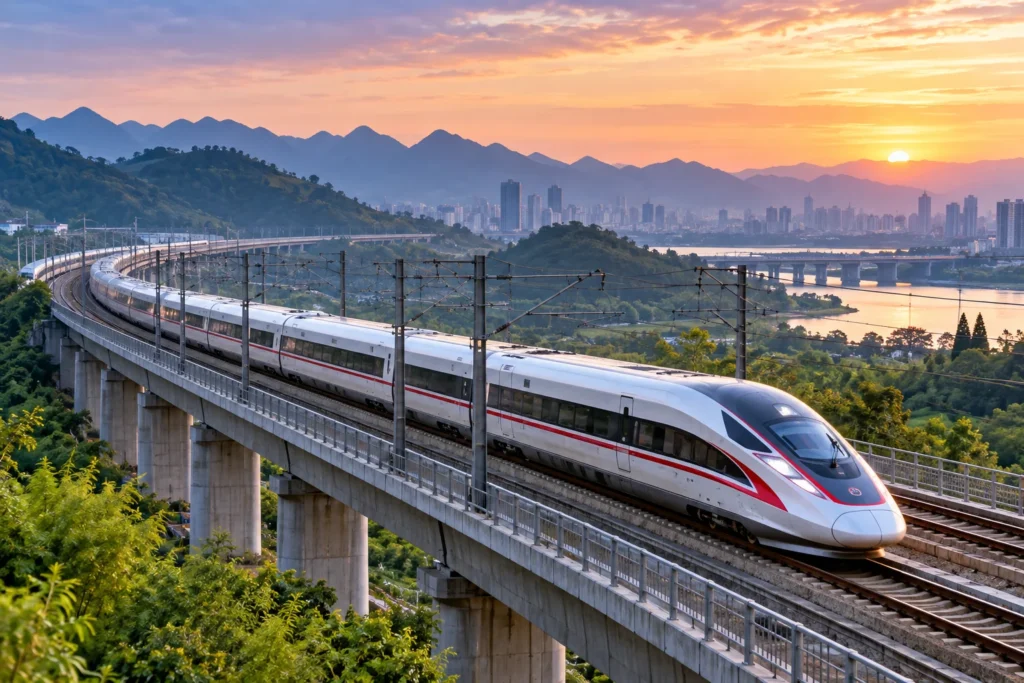
China State Railway Group announced the simultaneous opening of four major high-speed railway corridors spanning northern, northeastern, northwestern, and central regions of the country. The strategic infrastructure expansion brings additional cities and interior counties into the national high-speed grid, significantly reducing transit times between major urban centers and emerging leisure destinations right before the peak Golden Week National Day holiday period.
The four newly operational routes include the Xiong’an-Shangqiu section of the Beijing-Hong Kong high-speed railway, the Xi’an-Ankang section of the Xi’an-Chongqing high-speed line, the Yichang-Xingshan connection, and the Harbin-Yichun railway line.
National transportation authorities confirm that expanding regional rail links directly stimulates tourism consumption, diversifies holiday travel choices, and distributes visitor demand more evenly across smaller, culturally rich destinations.
Route Specs and Travel Time Reductions
| High-Speed Railway Section | Distance Covered | Fastest Journey Time | Key Destinations Connected |
| Xiong’an – Shangqiu | 522 Kilometers | 2 Hours 27 Minutes | Renqiu, Suning, Shenzhou, Hengshui, Liaocheng, Heze |
| Xi’an East – Ankang West | 171 Kilometers | 45 Minutes | Guanzhong region, Zhashui, Zhen’an, Qinba mountain area |
| Yichang – Xingshan | Network Link | Saves 1 Hour+ (Wuhan-Chongqing) | Connects Shanghai-Chongqing-Chengdu & Zhengzhou-Chongqing corridors |
| Harbin – Yichun | 318 Kilometers | 1 Hour 46 Minutes | Heilongjiang forest zones, subarctic eco-tourism hubs |
Enhancing Regional Mobility and Holiday Travel Choice
The launching of these transit lines comes during an intense travel rush sandwiched between the Mid-Autumn Festival and the upcoming seven-day National Day holiday period. Official daily passenger statistics provided by China State Railway Group indicate that national rail networks carried over 14.37 million passenger trips on a single Saturday, rising to an estimated 16.86 million trips on the peak return day of the Mid-Autumn holiday.
By establishing direct bullet train links to smaller municipal counties—such as Renqiu, Suning, and Shenzhou in Hebei Province, as well as Zhashui and Zhen’an in Shaanxi Province—travelers gain convenient access to secondary scenic zones. Official destination managers note that expanded rail choices enable travelers to avoid overcrowded traditional urban tourist hotspots, spreading economic spending into rural communities, alpine resorts, and eco-tourism reserves.
Regional tourism statistics illustrate the growing appetite for holiday travel across the national network. During recent holiday periods, major metropolitan centers like Beijing recorded over 8.78 million tourist visits, generating 11.54 billion yuan in holiday consumption. Similarly, southern hubs like Guangdong recorded over 24.81 million visitor trips, yielding 12.55 billion yuan in revenue. The introduction of faster regional rail connections allows smaller counties along the new corridors to compete directly for upcoming National Day travel demand.
Engineering Breakthroughs Across Complex Environmental Terrain
The successful opening of these four rail corridors showcases advanced railway engineering designed to overcome diverse geographical and environmental conditions. The routes traverse complex topographies, ranging from the flat North China Plain and the rugged Qinling Mountains to the mountain valleys of western Hubei and the frozen ground of Northeast China.
Building the Harbin-Yichun high-speed line required specialized engineering solutions to cross discontinuous permafrost zones in northern Heilongjiang. Project engineering teams utilized ground pre-thawing techniques, soil replacement, thermosyphons, and specialized thermal insulation panels to ensure track stability over permafrost during seasonal temperature changes.
Simultaneously, operational safety across expanding high-speed routes relies on advanced digital management systems. Integrated maintenance networks across national trunk lines utilize BeiDou satellite navigation, automated sensor arrays, and unmanned drone aerial inspections to conduct predictive risk assessments, supporting safe, high-frequency passenger transit during extreme holiday traffic volume.
Through continued high-speed rail integration, national tourism authorities continue to unlock interior cultural and natural destinations, offering international and domestic travelers seamless connectivity across China’s diverse regional landscapes.
For more travel news like this, keep reading Global Travel Wire