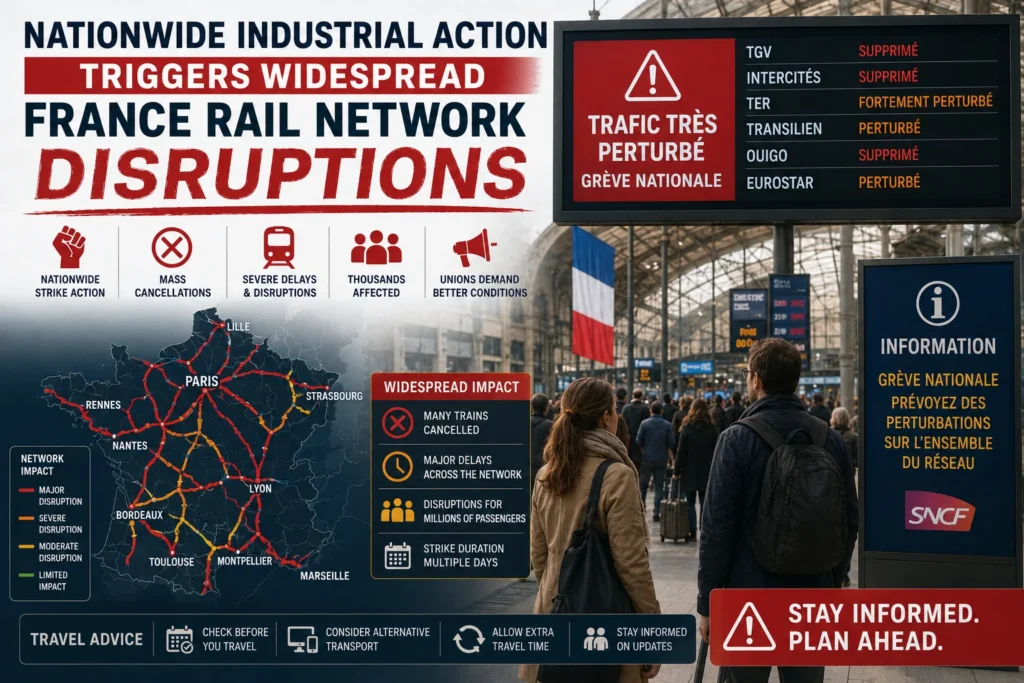
Travelers across France are experiencing major transit complications today as a coordinated, nationwide industrial dispute sharply curtails the capacity of the country’s public transport infrastructure. According to formal transport updates released by the state-owned railway operator, French National Railways (SNCF), all four primary labor syndicates—including the CGT-Cheminots, Sud-Rail, Unsa-Ferroviaire, and CFDT-Cheminots—have executed their first fully unified, 24-hour joint walkout since late 2024. The massive strike window, which officially initiated at 19:00 on the evening of Tuesday, June 9, is statutory to continue affecting operations until 06:00 on the morning of Thursday, June 11, making Wednesday, June 10, the absolute peak of network-wide cancellations.
Official statements from union leadership clarify that the industrial action was mobilized in direct opposition to internal corporate restructuring strategies, specifically the creation of localized subsidiaries designed to manage regional rail competitive tendering processes. Representatives argue these shifting administrative frameworks impact workforce stability, while also raising persistent structural grievances regarding worker purchasing power relative to ongoing cost-of-living fluctuations.
High-Speed and Intercity Corridors Face Significant Service Cuts
The operational transport plans published by SNCF Voyageurs reveal a substantial decline in active train paths along primary domestic and international high-speed routes. Data confirms that approximately one-third of all standard high-speed services—encompassing TGV INOUI, OUIGO, and the cross-border TGV Lyria routes—have been completely cancelled today. While the operator maintains that the remaining two-thirds of the high-speed fleet will continue to move travelers throughout the day by utilizing remaining available seating capacity, corporate business travel schedules are experiencing notable adjustments.
The impact is even more severe across the classic Intercités long-distance conventional network. Official schedules indicate that exactly half of the normal daytime and overnight Intercités services have been systematically grounded. Regional TER rail systems are similarly suffering from severe, highly fragmented disruptions, with individual regional directorates urging travelers via localized travel portals to defer non-essential regional journeys entirely until normal capacity can be fully restored.
International Rail and Paris Airport Links Under Pressure
The industrial action has also extended its ripple effects into cross-border European travel and critical airport transit corridors. International operators have confirmed selective cancellations directly tied to the French network constraints, resulting in the official grounding of specific high-profile international departures, including Eurostar trains 9007 and 9036.
Closer to the capital, commuters and international flight passengers navigating the Île-de-France commuter networks face challenging conditions. While the autonomous transport operator RATP confirms that the central Paris Metro, regional bus lines, and the urban tramway network are operating normally as they do not share the SNCF labor framework, the outer commuter trains are heavily impacted. Transilien lines are running on restricted schedules, and the RER B arterial line—which serves as the vital transit link to Paris Charles de Gaulle (CDG) Airport—has been severely degraded.
SNCF operational manifests confirm that only half of the typical train volume is running on the northern section of RER B between Gare du Nord and the airport, while two-thirds capacity is maintained on the southern branch. International travelers are being formally instructed by airport authorities to factor significant additional buffer time into their airport transfer strategies.
Immediate Action Required to Secure Ticket Refunds
In light of the extensive cancellations, SNCF has initiated an automated messaging protocol to contact all affected ticket holders via SMS and email. Under enforced passenger rights frameworks, individuals whose scheduled trains have been officially removed from the daily manifest are legally entitled to a full, unconditional financial refund or the option to modify their itinerary to an alternative departure free of any processing fees or fare discrepancies.
However, consumer protection directives outline a critical procedural caveat: travelers must actively initiate their compensation claims or structural exchanges before the exact scheduled departure time printed on their physical or digital ticket. Attempting to process requests through the standard digital booking portals, mobility applications, or telephone service hotlines after the train’s nominal departure slot has passed can result in the forfeiture of immediate automated refund privileges.
Full service recovery across the national French rail grid is officially forecasted to commence from 06:00 on Thursday, June 11, though regional transit boards warn that localized residual delays and minor positioning bottlenecks may persist through the early hours of Thursday morning as rolling stock is reassigned to its proper geographic depots.
For more travel news like this, keep reading Global Travel Wire