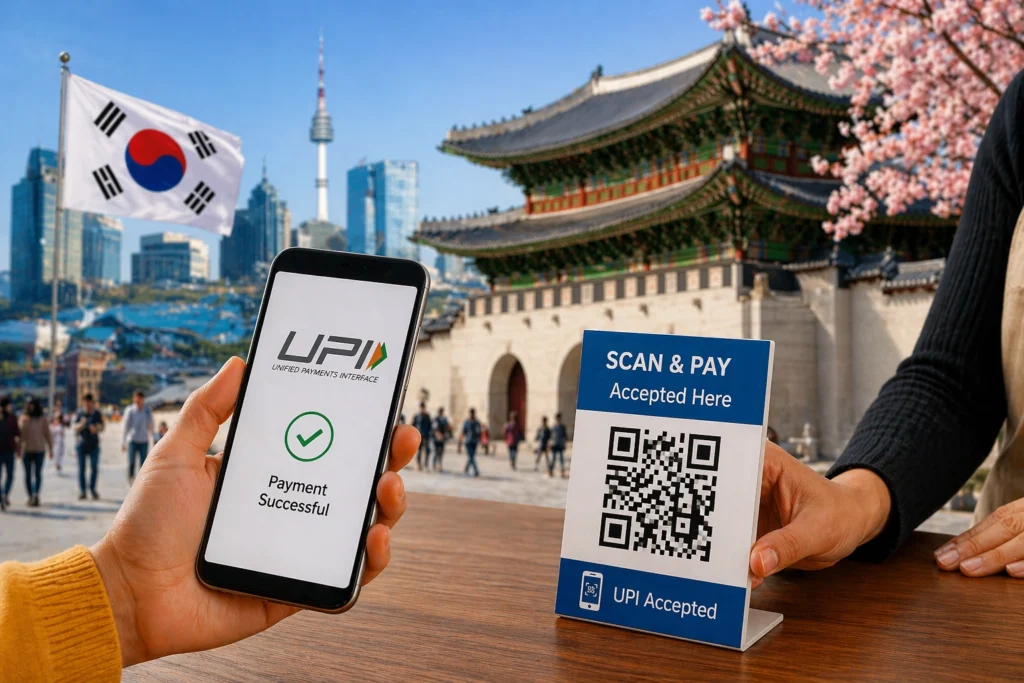
India’s Unified Payments Interface (UPI) has expanded into South Korea, marking a major milestone in cross-border digital payments and transforming how Indian travellers manage expenses overseas. The integration enables seamless QR-based transactions, allowing visitors to pay using familiar mobile apps without relying heavily on cash or international cards.
The development reflects a growing global shift toward interoperable payment systems, where travellers can move across borders without financial friction. For Indian tourists heading to South Korea, the update simplifies everyday spending—from meals and shopping to transport—while strengthening tourism flows between the two countries.
A Breakthrough for International Travel Payments
For years, one of the biggest challenges for international travellers has been managing payments in foreign destinations. Currency exchange, card fees, and limited acceptance often complicate even simple transactions.
With UPI integration, Indian travellers can now use QR-based payment methods in South Korea much like they do at home. By scanning merchant codes and paying directly from their bank accounts, users benefit from a fast, secure, and familiar system.
This change significantly reduces the need to carry cash or depend solely on global card networks, making travel more efficient and less stressful.
How the System Works for Travellers
The agreement links India’s UPI network with South Korea’s domestic digital payment infrastructure, enabling interoperability between the two systems.
Indian travellers will be able to use widely adopted apps such as Google Pay, PhonePe, and Paytm to complete transactions abroad. Payments can be made by scanning QR codes at participating merchants, with funds debited directly from Indian bank accounts.
At the same time, Korean visitors to India will also benefit from the integration, as they gain access to compatible payment methods during their travels.
This two-way system supports both inbound and outbound tourism while encouraging smoother financial transactions across borders.
Tourism Benefits for Both Countries
The impact of UPI expansion extends beyond convenience. Easier payment systems can influence travel decisions, particularly for first-time international travellers who may feel uncertain about managing money abroad.
For South Korea, the integration enhances its appeal to Indian tourists by offering a frictionless payment experience in retail stores, restaurants, attractions, and local services. It also supports small businesses by enabling them to accept payments from a rapidly growing outbound travel market.
For India, the move strengthens its position as a global leader in digital payments and reinforces economic and tourism ties with a key Asian partner.
UPI’s Expanding Global Footprint
UPI has been steadily extending its reach beyond India, already operating in markets such as the United Arab Emirates, Singapore, France, Mauritius, and Nepal. South Korea’s inclusion represents another significant step in building a global digital payments ecosystem.
As one of the world’s largest real-time payment platforms, UPI processes billions of transactions and has become a model for scalable fintech infrastructure. Its international expansion aligns with broader efforts to simplify travel, reduce transaction costs, and promote digital financial inclusion.
For global tourism, this signals a future where travellers can rely on a single payment ecosystem across multiple destinations.
Practical Advantages for Indian Travellers
For those planning trips to South Korea, the integration offers several immediate benefits:
Everyday transactions become faster and more convenient
Reduced need for currency exchange before departure
Lower reliance on credit or debit cards
Improved security compared to carrying large amounts of cash
These advantages are particularly useful in urban travel environments where quick, small payments are frequent.
Limitations in the Early Phase
Despite the benefits, travellers should be aware that the rollout may initially be limited. Not all merchants may support QR-based payments immediately, and acceptance could vary depending on location.
As a result, travellers are advised to carry backup payment options such as international cards or some local currency, especially during the early stages of implementation.
Over time, acceptance is expected to expand as more businesses adopt the system.
A Step Toward Cashless Global Travel
The India–South Korea payment integration reflects a wider trend in global tourism toward digital-first experiences. As countries increasingly adopt interoperable payment systems, cross-border travel is becoming more seamless and accessible.
For airlines, hotels, and tourism businesses, easier payments can translate into higher spending, improved customer satisfaction, and stronger visitor flows.
What Travellers Should Do Next
To make the most of the new system, travellers should ensure their UPI apps are active, linked to their bank accounts, and enabled for international use. Staying informed about participating merchants and carrying backup payment methods will also help ensure a smooth experience.
Looking Ahead
The expansion of UPI into South Korea marks a significant milestone in the evolution of travel convenience. As digital payments continue to break down barriers between countries, the future of tourism is becoming more connected, efficient, and traveler-friendly.
For Indian travellers, the journey abroad is no longer just about reaching a destination—it is about experiencing it with the same ease and confidence as back home.
For more travel news like this, keep reading Global Travel Wire