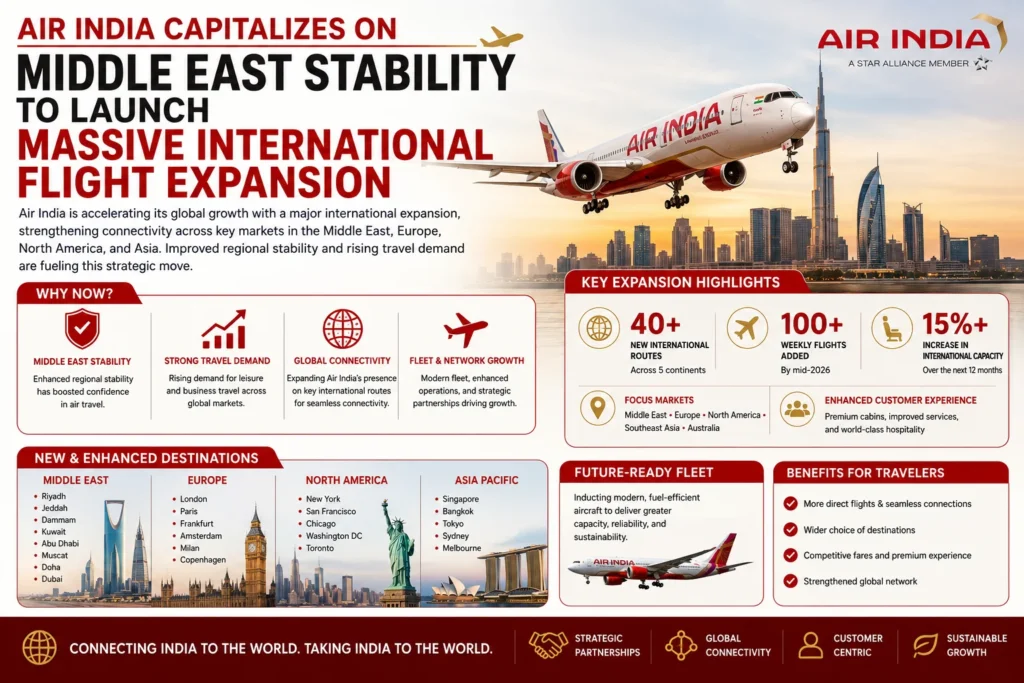
Global aviation and leisure tourism corridors are adjusting rapidly to improving regional conditions. Air India has announced a comprehensive evaluation to scale up its international flight operations following a noticeable easing of geopolitical tensions in the Middle East. The national carrier is reviewing the reinstatement of several lucrative global routes that were previously rationalized, suspended, or structurally modified due to regional airspace constraints.
This decisive pivot stems directly from an internal directive from corporate leadership, which notes that stabilized airspace boundaries and a sharp drop in international aviation turbine fuel (ATF) costs have presented an ideal window to restore the carrier’s global footprint. Over recent months, the airline had proactively reduced operations on multiple long-haul routes to manage escalating overheads and minimize sudden delays for international leisure and business travelers. With normalized flight paths now widely available, the airline is shifting away from safe-routing detours toward highly efficient, direct transits.
Airspace Normalization Drives Route Restorations
Official tracking data reveals that previous airspace closures across parts of the Middle East had forced commercial carriers into lengthy diversions over European and Asian corridors. These detours increased flight times, expanded crew duty rotations, and dramatically amplified fuel consumption per passenger. To protect network integrity, Air India had implemented a strategic scale-back, suspending operations across three major international pathways and trimming weekly frequencies on 26 other key global routes.
With the regional situation stabilizing, the financial viability of long-haul tourism has drastically improved. More direct flight paths mean lower carbon emissions and reduced operational costs per flight hour. The airline’s management indicated that if current stable conditions persist, the recent schedule reductions will be systematically reversed. This move aims to benefit the broader travel sector by restoring over 250 previously cut weekly international flights, facilitating more seamless travel between India, Europe, and North America.
Fleet Augmentation with New Wide-Body Jets
To support this rapid international growth, Air India is executing a significant fleet expansion, with plans to integrate eight more new or refurbished wide-body aircraft before the end of the calendar year. This upcoming capacity boost is part of a broader fleet modernization campaign that includes the induction of advanced line-fit Boeing 787-9 Dreamliners and Airbus A350-1000 models, alongside the thorough cabin retrofitting of legacy Boeing 787-8 aircraft.
By deploying these modernized aircraft featuring multi-class cabin configurations—including Premium Economy options—the carrier is well-positioned to meet the peak demand for international vacation travel. The addition of these wide-body jets allows the airline to optimize its load factors on high-demand routes, improving the passenger experience with state-of-the-art cabin interiors and upgraded in-flight services.
Strengthening East Asian and Middle Eastern Networks
The airline’s global strategy has already delivered major network expansions into vital destination hubs. Air India recently launched four new weekly non-stop flights between Mumbai and Tokyo Haneda, effectively supplementing its established daily service from Delhi to the Japanese capital. This expansion enhances access for business and cultural tourism between India and East Asia.
Simultaneously, the airline is deepening its connectivity to primary Middle Eastern hubs. Over the coming months, its low-cost subsidiary, Air India Express, will make aviation history by operating the inaugural direct international passenger flight from the newly constructed Navi Mumbai International Airport, connecting travelers directly to Abu Dhabi. Furthermore, new direct point-to-point services are rolling out from regional Indian airports like Guwahati to major hubs like Dubai and Abu Dhabi. This network diversification reduces reliance on any single market while opening new transit points for international holidaymakers.
Record Operational Stability for the Summer Season
Internal performance metrics for the current season show that Air India has established a strong foundation for this international rollout. The airline logged its strongest operational month of the year, achieving an overall on-time performance (OTP) rate of 86 percent. This high scheduling reliability minimizes operational disruptions and builds confidence among global travel agencies booking long-haul itineraries.
The combination of high operational performance, declining international fuel overheads, and the steady introduction of long-range wide-body jets positions the airline to capture a larger share of the outbound tourism market. By adjusting flight pricing and flight frequencies as direct routes reopen, the airline’s expansion is expected to stimulate competitive pricing across the long-haul sector, lowering entry costs for international tourists flying between India and western destinations.
For more travel news like this, keep reading Global Travel Wire