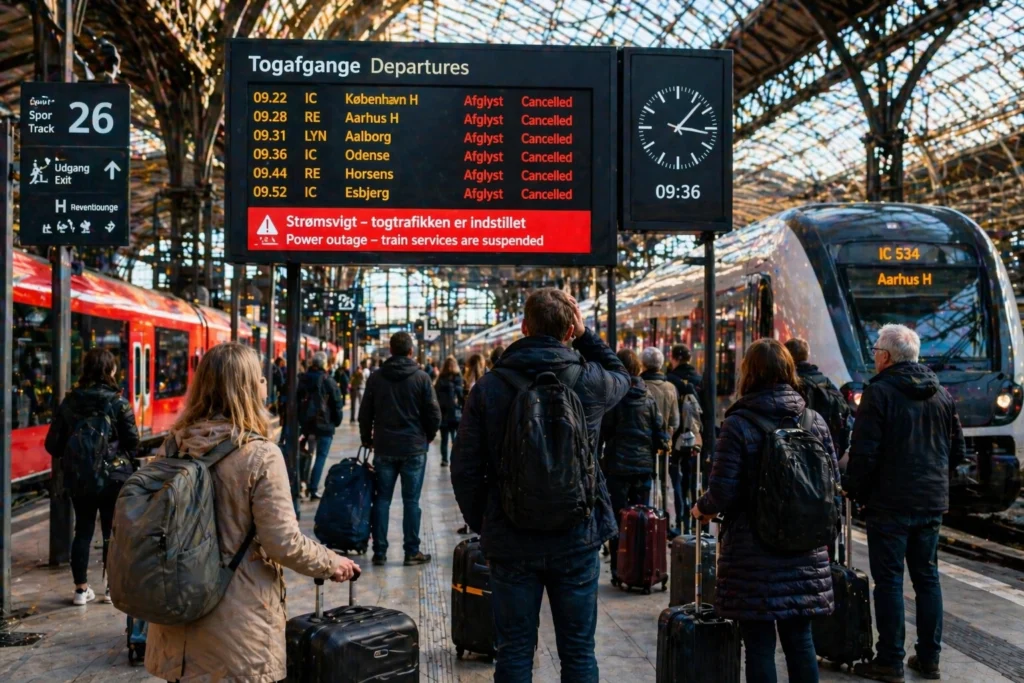
A major rail disruption in Denmark during April 2026 has highlighted how critical transport infrastructure failures can quickly escalate into a national travel crisis, affecting tourism, airport access and regional mobility. What began as a technical issue in the eastern rail electrification system expanded into a wide-reaching shutdown that disrupted commuter services, long-distance journeys and key passenger links in one of Northern Europe’s most rail-dependent nations.
The incident has raised fresh questions about infrastructure resilience at a time when rail is increasingly promoted as the backbone of sustainable travel across Europe. For travelers, it underscored how seamless journeys depend on systems rarely noticed until they fail. For destinations and tourism businesses, it showed how transport reliability directly shapes visitor confidence and economic performance.
Network Failure Triggers Widespread Travel Chaos
The disruption centered on a breakdown in overhead electrification east of Odense, forcing the suspension of electric train services across multiple corridors. Denmark’s eastern rail network connects major cities, commuter zones, ports and airport routes, meaning the impact spread quickly beyond the immediate fault area.
Within hours, passengers faced cancellations, long delays and rapidly changing travel advice. For a country known for efficient and dependable public transport, the scale of the outage was especially striking.
Transport incidents of this kind can have an outsized effect because modern rail networks operate as interconnected systems. A failure in one area can ripple across timetables, staffing, rolling stock rotations and passenger flows nationwide.
Airport Access and International Travel Hit Hard
One of the most immediate tourism impacts involved airport access. Rail links often provide the fastest and most sustainable route to major airports, particularly for international travelers carrying luggage or working to tight schedules.
With services suspended, demand for taxis, ride-hailing services, rental cars and replacement buses surged. Higher prices, limited availability and road congestion added further pressure. Some travelers reportedly missed flights, increasing stress and additional travel costs.
For business travelers and international visitors, dependable airport connectivity is a key factor when choosing transit hubs and planning itineraries.
Tourism Sector Feels Immediate Pressure
April typically marks the beginning of the spring travel season, when city breaks, coastal escapes and cultural visits begin to accelerate. Rail plays a central role in helping visitors move easily between Danish destinations without needing a private car.
As services were reduced or halted, tourists encountered missed connections, altered itineraries and uncertainty around day trips. Hotels and tour operators saw increased inquiries from guests concerned about onward travel and arrival times.
Regional destinations that depend heavily on train access can be particularly vulnerable during such disruptions, especially smaller towns where visitor spending supports local restaurants, attractions and seasonal businesses.
Capacity Problems Continue After Repairs
The impact did not end with infrastructure restoration. More than thirty electric trains were reportedly damaged during the incident, reducing available rolling stock even after partial service resumed.
That created longer-term constraints including shorter train formations, lower frequencies and overcrowding on restored services. For travelers, the result was a weaker experience even after the headline crisis passed.
This is a common challenge in transport recovery: rebuilding operations often takes longer than fixing the initial fault.
Sustainability Goals Tested
Denmark has promoted rail as a low-emission alternative to road travel and short-haul flights. However, when rail capacity disappears suddenly, passengers often shift to cars or buses.
That temporary modal shift can increase congestion and emissions, showing how fragile sustainability gains can be when resilience planning is insufficient. Green transport systems need robust backup strategies if they are to remain credible during disruptions.
For policymakers across Europe, the lesson is clear: decarbonization and reliability must advance together.
What the Crisis Revealed
The disruption exposed how even a localized mechanical failure can become a national mobility issue when critical systems lack redundancy or early-warning protections.
It also reinforced the value of predictive maintenance, real-time monitoring and transparent passenger communication. Travelers are often understanding when problems occur, but confidence depends on clear updates and visible recovery plans.
In tourism, reliability is part of the destination product. Visitors judge not only attractions and hotels, but also how easily they can move around.
Wider Lessons for European Rail Travel
Denmark’s network links into wider European transport corridors, so major disruptions can also affect cross-border schedules and onward journeys. As Europe encourages more medium-distance rail travel, infrastructure resilience is becoming a continental priority.
Reliable rail networks are essential for multi-country itineraries, business travel and the shift toward lower-carbon transport.
Looking Ahead
The April 2026 disruption was more than a technical breakdown. It was a reminder that transport systems are central to tourism competitiveness, economic activity and traveler trust.
For Denmark, future investment in maintenance, redundancy and recovery systems will be crucial. For travelers, the event highlights a simple truth: the best journeys depend not only on destinations, but on the invisible infrastructure that gets people there.
For more travel news like this, keep reading Global Travel Wire