International border processing is undergoing an unprecedented structural overhaul as civil aviation authorities, national transport ministries, and sovereign border agencies execute a complete modernization of global travel infrastructure. Driven by verified government initiatives and official aviation data, standard border checkpoints are transitioning toward a completely integrated, automated ecosystem. The rapid implementation of advanced airport security technology, cloud-based risk prediction systems, and contactless digital verification networks is fundamentally redefining the relationship between traveler safety, regulatory compliance, and operational efficiency across the global tourism sector.
According to official administrative updates from major transit hubs, this development represents a structural shift from traditional, uniform security protocols to highly targeted, data-driven border management. Rather than subjecting every traveler to identical, repetitive manual verification loops, modern state infrastructure utilizes predictive algorithms to analyze border throughput patterns, optimize personnel deployment, and isolate potential vulnerabilities well before they impact airport operations. The result is a highly agile network that processes lower-risk passengers within seconds while focusing state resources on specialized security needs.
Biometric Verification and Next-Generation Gates Accelerate Border Crossings
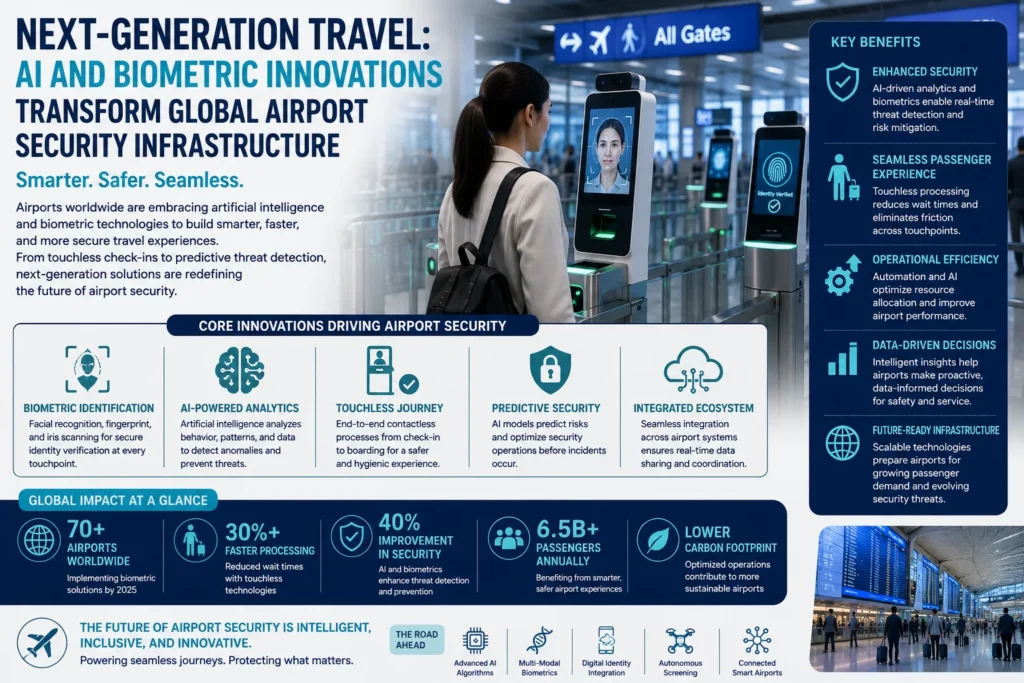
The widespread deployment of contactless biometric verification is rapidly establishing a paperless, friction-free environment for international arrivals and departures. Official directives published by the European Union regarding the phased implementation of its automated Entry/Exit System (EES) emphasize the replacement of manual passport stamping with high-precision facial recognition and digital fingerprint capturing. These automated biometric gates systematically cross-reference live passenger scans against secure state databases, completing comprehensive security sweeps without requiring physical interaction with paper credentials.
Aviation operational metrics show that these automated systems drastically cut down terminal processing windows. At major international hubs, such as Frankfurt and Singapore Changi, travelers moving through newly upgraded biometric screening lanes experience verified processing times of less than ten seconds per individual. Because biometric identifiers are inherently anchored to the physical passenger rather than a paper booklet, the technology provides unmatched defenses against identity fraud and document alteration, giving border authorities high levels of precision while accelerating passenger movement through busy terminals.
The Rise of Sovereign Digital Identity Wallets and Protected Mobility Frameworks
In tandem with physical terminal upgrades, government agencies are building decentralized software architectures to grant travelers greater autonomy over their personal credentials. Under frameworks like the European Digital Identity Wallet initiatives and trusted traveler programs managed by the United States Department of Homeland Security, passengers can securely cache verified biometric data, international visas, and state-issued identifications locally on personal smart devices.
This encrypted storage method eliminates the need to carry physical documents, which are highly susceptible to loss or theft during multi-leg international itineraries. Operating on privacy-by-design principles, digital wallets utilize selective data disclosure mechanisms. This means travelers can verify their eligibility to cross a border or board an aircraft by sharing only the exact, necessary data points with border agents or airline operators, leaving the remainder of their private information completely secure. Sovereign ministries across the Asia-Pacific region are increasingly weaving these digital wallets into national transit infrastructures, laying the groundwork for a standardized, globally interoperable network.
Interconnected Command Ecosystems Protect Digital Travel Infrastructure
As the global travel matrix transitions to an interconnected framework defined by cloud-hosted reservations, mobile boarding profiles, and automated baggage tracking, national cyber-defense agencies are dramatically scaling up their protective protocols. Because centralized travel databases handle sensitive payment metrics and personal identification histories, they represent primary targets for international cyber-threat networks. To counter this, state transportation departments are mandating the integration of behavioral analytics and continuous multi-factor authentication loops across all reservation platforms.
Simultaneously, transportation agencies are utilizing real-time global tracking networks to counter non-cyber disruptions, such as extreme weather events, regional strikes, and critical infrastructure failures. Modern flight command centers operate via digital twins—fully virtualized replicas of active airport environments that simulate passenger flows and airline schedules under various stress scenarios. When extreme weather or operational challenges emerge, these smart systems automatically trigger contingency protocols, allowing airport operators to redirect resources, adjust incoming flight paths, and update affected travelers via automated alerts well before a crisis clogs physical terminal spaces.
International Compliance and the Evolution of Shared Border Governance
The global deployment of these advanced technological systems presents unique challenges regarding cross-border compliance, ethical governance, and data retention limits. To prevent fragmented regional systems that could cause long processing delays for international travelers, the International Civil Aviation Organization (ICAO) is working closely with sovereign nations to establish unified, global benchmarks for digital identity verification.
Sovereign tourism boards and aviation authorities emphasize that the long-term success of automated transit relies heavily on absolute transparency. Government guidelines are being systematically updated to ensure that travelers understand exactly how their biometric data is processed, which agencies are granted viewing access, and the strict timelines governing data deletion. By balancing necessary state security parameters with rigorous personal privacy protections, global border authorities are creating a highly secure, efficient, and resilient travel environment built to accommodate the rising volumes of modern international tourism.
For more travel news like this, keep reading Global Travel Wire