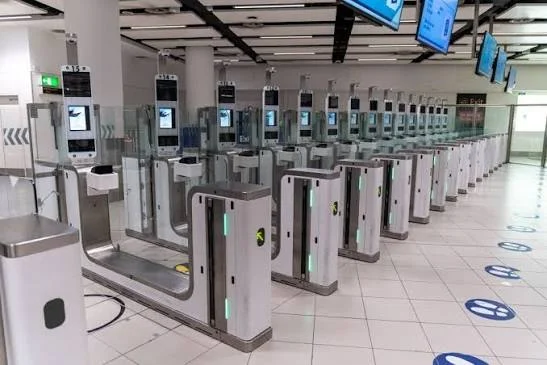
The UK has begun introducing contactless eGates, allowing eligible passengers to complete automated border checks without initially scanning their passports. East Midlands Airport launched the technology on 6 October 2026, ahead of expansion to other major gateways.
Initial access covers British citizens entering on British passports. Other nationalities already eligible for conventional eGates are expected to join as the programme develops.
The government expects airport eGates to receive the upgrade by early 2027. Testing indicates contactless processing can be up to 25% faster than the conventional passport-scanning procedure.
For travellers, the change could improve the arrival experience during busy periods. However, the testing result does not guarantee an equivalent reduction in overall immigration queues.
East Midlands Introduces the First Gates
A small number of contactless eGates are initially available at East Midlands Airport.
The phased introduction means passengers should follow local signage and instructions rather than expect every gate to operate identically.
Existing airport eGate infrastructure will receive software upgrades, allowing the programme to develop without wholesale replacement of the equipment.
Passengers approaching a contactless gate will have a live facial image captured. The system checks that image against verified records before completing the required border checks.
Successful verification allows the gate to open. Border Force officers remain involved in monitoring automated processing and assisting passengers. GOV.UK
For airports, introducing the system gradually provides time to manage passenger guidance alongside normal arrival operations.
Heathrow, Gatwick and Manchester Are Included
The programme covers several of Britain’s busiest international arrival points.
Heathrow, Gatwick, Manchester and Stansted feature among the airports included in the phased upgrade. Birmingham, Bristol, Cardiff, Edinburgh and Glasgow are also listed.
The remaining locations include London City, Luton and Newcastle, alongside the initial East Midlands deployment.
Together, these gateways serve varied leisure, business and visiting-friends-and-relatives markets.
Their inclusion gives the programme significance beyond one airport, although availability will depend on rollout progress at each location.
Tour operators, transfer providers and hotels may eventually benefit from more predictable arrivals. However, no quantified tourism or hospitality impact accompanies the announcement.
Physical Passports Remain Essential
Contactless processing changes the interaction at the gate, rather than removing the need for a passport.
Travellers must still carry a valid physical passport and keep relevant documents accessible.
If facial verification cannot complete the checks, passengers may need to scan their passport using the existing reader. Some may instead be referred to a Border Force officer.
These alternatives preserve a route for additional verification when automated processing cannot resolve a journey.
The same immigration and security controls continue behind the contactless process.
For passengers, the most useful preparation remains having documents ready and allowing time for normal arrival formalities.
Wider eGate Eligibility Has Separate Conditions
The contactless launch should be distinguished from eligibility to use conventional eGates.
Initially, the new process is available to British citizens travelling on British passports at participating airports. Wider contactless access is expected during the rollout.
Conventional eGate use has already expanded for families. From 8 July 2026, eligible children aged eight and nine joined older children using automated channels.
Children aged eight to 17 must be accompanied by an adult and meet the applicable minimum height requirement.
The government estimated that the age change could make another 1.5 million children eligible over a year.
Families should therefore check both general eligibility and the instructions applying at their arrival airport.
Digital Permission Still Needs to Match the Journey
Some overseas passengers require an Electronic Travel Authorisation, eVisa or another applicable immigration permission.
Missing, invalid or unconfirmed digital permission can create difficulties at an eGate. Contactless technology does not remove those underlying requirements.
Certain travellers must also use staffed controls. Qualifying passengers entering under the short-term Creative Worker concession require an officer to provide an entry stamp.
These distinctions matter when planning travel because automated processing cannot serve every entry circumstance.
Passengers should establish the correct arrival channel before joining a queue, particularly when their permission requires additional action.
Faster Processing Could Improve Visitor Arrivals
For the tourism industry, border processing forms an important part of the first impression visitors receive.
International arrivals can place concentrated pressure on immigration halls when several flights land close together.
Removing one step from eligible checks could improve passenger flow through existing facilities. Nevertheless, baggage delivery, flight timing and further inspections will still influence the complete airport journey.
As the rollout expands, clear communication will remain central to its effectiveness. Travellers need to know where contactless gates operate and whether they qualify.
The immediate development offers a new arrival process at East Midlands, with broader access planned as Britain upgrades its airport border network.
For more travel news like this, keep reading Global Travel Wire