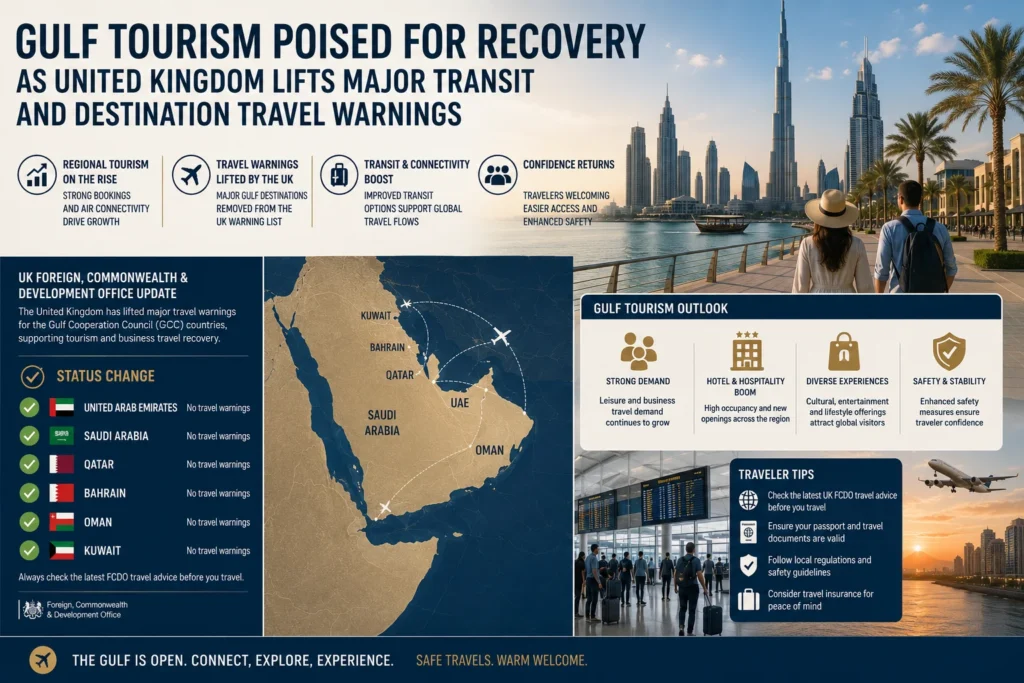
A major diplomatic breakthrough has triggered a sweeping shift across the global leisure and business travel sectors, as the United Kingdom government formally dismantled its strict restrictions against traveling to several premier destinations in the Middle East. According to newly updated resolutions published by the British Ministry of Foreign Affairs, also known as the Foreign, Commonwealth and Development Office, the government has lifted its blanket recommendation advising citizens against all non-essential transit to the United Arab Emirates, Qatar, and a substantial portion of Saudi Arabia.
The comprehensive policy downgrade serves as an immediate catalyst for the international aviation and hospitality markets. For nearly four months, rigid travel warnings had effectively invalidated standard consumer travel insurance policies, introducing immense financial friction for global holidaymakers and creating widespread logistical hurdles for regional airlines. This sweeping administrative reversal is expected to quickly unlock late-season bookings and revive the primary long-haul stopover corridors that bridge Western Europe with Asia and Africa.
Strategic Diplomatic Framework Unlocks Air Space and Transit Corridors
The sudden normalization of British travel protocols comes on the heels of an official memorandum of understanding signed between the United States and Iranian authorities. This high-level international accord aims to systematically wind down regional military hostilities and secure open transit through key international waterways, including the critical Strait of Hormuz.
Prior to this diplomatic resolution, the British government had significantly hardened its security guidance following targeted military actions launched in late February. The initial escalation had severely disrupted commercial air networks, closing off strategic high-altitude flight paths and forcing multiple flagship carriers to cancel long-haul routes entirely. The resulting transit freeze stranded thousands of foreign nationals throughout the Gulf and necessitated complex state-coordinated evacuation logistics.
While the new bilateral memorandum clears a path for normal operations to resume, the Ministry of Foreign Affairs emphasizes that the overarching security profile of the Gulf remains in a state of delicate transition. Official travel advisories remind the public that regional conditions can shift rapidly and that defensive postures could be re-established on short notice. Because of this fluid environment, civil aviation boards advise travelers to remain highly informed, maintain direct communication with their respective airlines, and strictly follow the operational directives of local security personnel.
Tailored Directives Reshape Travel Boundaries Within Saudi Arabia
The updated British framework implements a highly precise, localized approach to safety mapping within the Kingdom of Saudi Arabia. Under the newly issued protocols, London has officially retired its non-essential travel warnings for both the Eastern Province and the central Riyadh Province. This targeted adjustment provides a vital boost to corporate travel and high-yield cultural tourism, allowing commercial entities and leisure operators to fully resume standard itineraries to the nation’s primary economic and urban zones.
However, specific security boundaries along the southern perimeter of the Kingdom remain strictly locked down. The government continues to enforce a total prohibition on all travel within a ten-kilometer zone directly bordering Yemen. Furthermore, an advisory against all but essential travel remains active for the broader geographic band situated between ten kilometers and eighty kilometers from that same international boundary limit. Outside of these specified border zones, the vast majority of Saudi Arabia’s expanding tourism ecosystem has been cleared for standard international arrivals.
A Staged Aviation Restart for Key Regional Destinations
Despite the sweeping removal of state-level travel bans, global airline networks are approaching the reopened air corridors with calculated, structural caution. Industry data indicates that while regional hub carriers based inside the Gulf have immediately moved to expand seat capacity and ramp up flight frequencies, several prominent Western European airlines are keeping partial schedule suspensions in place.
The prolonged nature of the aviation sector’s recovery stems from the complex logistical realities of international fleet management. Rerouting long-haul aircraft back to original flight paths requires extensive re-certification, updated safety audits from domestic aviation groups, and major crew re-allocations. Industry experts suggest that while short-term capacity will steadily grow throughout the summer, it may require several months for full, unrestricted commercial flight schedules to completely match pre-conflict baselines.
To actively counter consumer hesitation and build immediate confidence among prospective holidaymakers, major local carriers in the region have pioneered the integration of specialized, conflict-inclusive travel insurance policies. These complimentary or optional coverage packages provide international arrivals with direct financial protection, including specialized medical coverage, localized accommodation support, and flexible rebooking options in the event of sudden airspace adjustments.
As the regional sixty-day diplomatic negotiation window progresses, international tourism boards and transport groups continue to urge the traveling public to embrace an approach of proactive awareness. Staying systematically updated via official state advisory portals remains the most reliable strategy for passengers navigating the global travel landscape during this major phase of regional stabilization.
For more travel news like this, keep reading Global Travel Wire