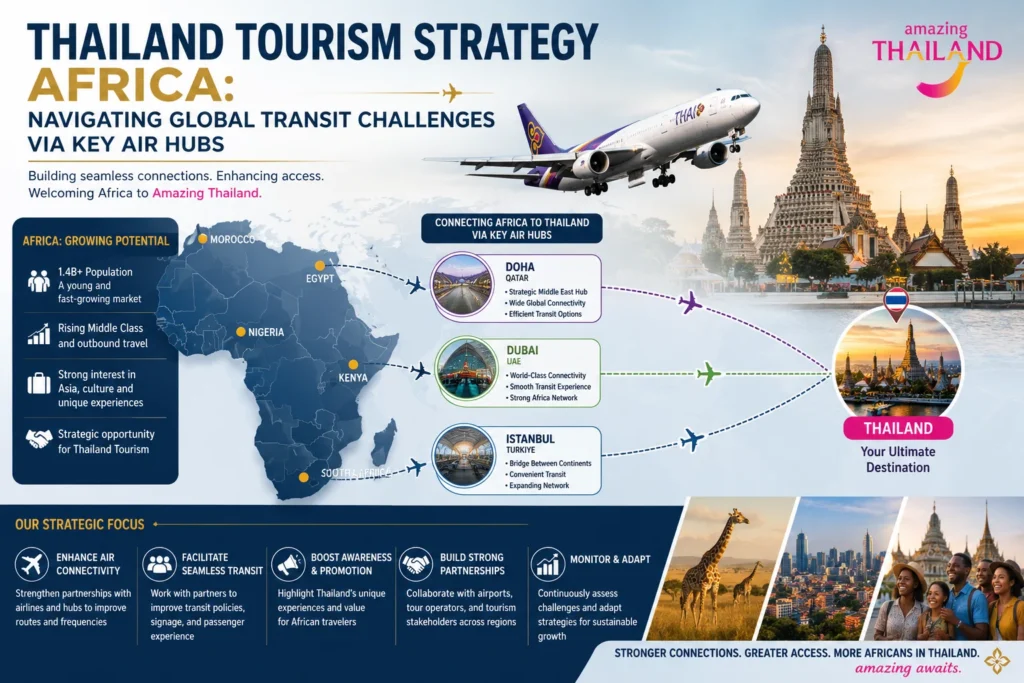
The global travel sector is adjusting to shifting transit patterns as destinations look to diversify their visitor demographics. In an official policy update presented at the Thailand Travel Mart Plus (TTM+) 2026 in Pattaya, the Tourism Authority of Thailand (TAT) announced a long-haul market development strategy specifically targeting growth across the African continent. This administrative pivot is designed to establish reliable traveler flows that bypass ongoing capacity constraints and operational fluctuations in traditional European and secondary transit sectors.
By coordinating with international airlines operating out of the Middle East and East Africa, Thailand aims to capture high-spending travel segments. The government’s structural approach leverages highly established aviation gateways to maintain steady luxury and leisure arrivals, securing the national tourism pipeline against external economic shocks.
Strategic Hub Consolidation via Major Air Bridges
A major element of Thailand’s market diversification relies on maximizing existing commercial flight capacities through highly efficient international air hubs. To counteract localized airspace congestion and schedule changes affecting direct routes, the tourism board’s long-haul blueprint emphasizes transit corridors via Dubai in the United Arab Emirates and Doha in Qatar. These hubs act as major global consolidation points, linking West, East, and South African markets directly to Southeast Asian networks.
In addition to Middle Eastern gateways, East African aviation infrastructure plays an important role in this network layout. Cooperation with carriers operating through Addis Ababa, Ethiopia, and Nairobi, Kenya, provides reliable, single-connection transit options for travelers from across the African continent. This operational framework allows long-haul visitors to avoid complex multi-carrier transfers, routing them straight into major Thai entry points like Bangkok and Phuket.
Statistical Telemetry of the African Visitor Market
Official metrics compiled by the Ministry of Tourism and Sports underscore the financial viability of this demographic pivot. According to official data as of May 25, 2026, Thailand welcomed a total of 63,031 visitors from African nations. While representing a emerging volume relative to historic short-haul markets, the economic yield per arrival remains distinct.
On average, travelers from the African market spent 56,279 baht (approximately US$1,710) per trip. Furthermore, government statistics show an average length of stay of 11.33 nights. This extended duration provides a steady source of revenue for hospitality operators and local communities, helping to offset the high-volume, short-stay travel segments that are more vulnerable to sudden transport disruptions and flight cancellations.
Targeted Growth in High-Yield Regional Markets
To maximize its promotional resources, the Tourism Authority of Thailand is focusing its international marketing campaigns on specific economic zones showing strong outbound momentum. Nigeria has recorded a notable 35 percent increase in visitor volume to Thailand, driven by an expanding middle class and an increasing demand for luxury and honeymoon travel experiences.
Similarly, tourist arrivals from the island nation of Mauritius have surged by 22 percent. On the continent, South Africa remains the primary priority market due to its substantial volume of outbound travelers and robust purchasing power. To sustain this momentum, the tourism board is planning a series of targeted trade missions and consumer events across major South African metropolitan areas, including Johannesburg, Cape Town, and Durban. Concurrently, to support these broader long-haul networks, the ministry is working to establish a dedicated operations office in Riyadh, Saudi Arabia, to strengthen its regional marketing presence.
Verified International Tourism Performance Metrics
The following structured overview outlines the official baseline performance indicators and strategic hub networks utilized under the current long-haul diversification program.
| Tourism Sector Metric | Verified Government Data |
| Total Registered African Arrivals | 63,031 visitors (As of May 25, 2026) |
| Average Revenue Yield Per Trip | 56,279 baht (~US$1,710) |
| Average Recorded Length of Stay | 11.33 nights |
| Outbound Growth Rate (Nigeria) | 35% increase in arrival volume |
| Outbound Growth Rate (Mauritius) | 22% increase in arrival volume |
| Core Regional Focus Territories | Johannesburg, Cape Town, and Durban (South Africa) |
| Strategic Air Transit Gateways | Dubai (UAE), Doha (Qatar), Addis Ababa (Ethiopia), Nairobi (Kenya) |
| Planned Institutional Expansion | New regional marketing office in Riyadh, Saudi Arabia |
Long-Term Integration and Domestic Tourism Objectives
For the broader hospitality and aviation sectors, this long-haul market development helps balance the seasonal fluctuations inherent to global leisure travel. By focusing marketing assets on regions that show consistent, year-round demand for high-end coastal and cultural experiences, destination managers can reduce their dependence on single geographic source markets.
Aviation analysis from the department highlights that building up capacity via Middle Eastern and African air bridges directly supports the national target of welcoming 33 million international visitors in 2026. The overarching policy directive, communicated under the theme of trusted and secure experiences, seeks to encourage arriving long-haul guests to explore secondary provinces beyond traditional hotspots like Phuket. This long-term approach aims to distribute economic benefits more evenly across municipal boundaries while expanding the country’s footprint within emerging global economies.
For more travel news like this, keep reading Global Travel Wire