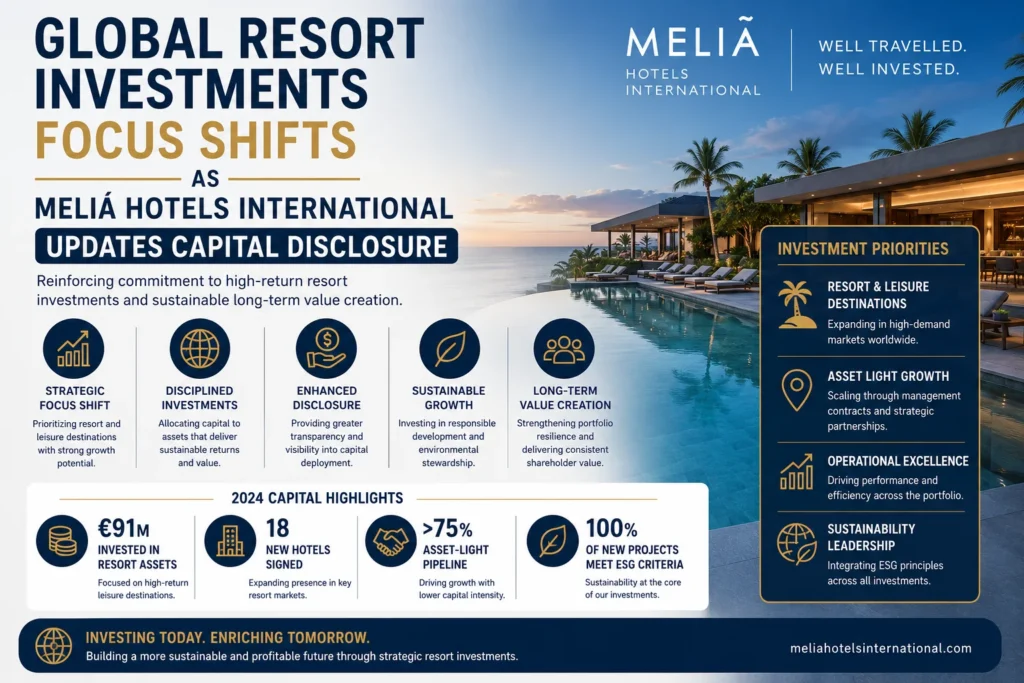
The structure of international hotel capital markets is drawing renewed analytical attention following a series of comprehensive corporate updates. Meliá Hotels International, a prominent Spanish-headquartered lodging group, has completed a major refreshing of its dedicated shareholder and stock market disclosure portals. This strategic realignment provides updated operational transparency concerning its capital structure, board governance, and global distribution network for equity and bond tracking entities.
As a leading hospitality organization operating extensively across diverse international leisure corridors, the company utilizes these formal registry modifications to outline its long-term financial stability. According to official corporate transparency declarations submitted to the Spanish National Securities Market Commission (CNMV), the update consolidates vital data regarding overall share counts, calculated free float parameters, and major institutional voting blocks. The centralizing of these regulatory governance matrices aims to provide international financial participants with a distinct view of institutional ownership mechanics.
Strengthening Financial Metrics and Governance Frameworks
The structural optimization follows a sequence of key corporate milestones executed by the group to refine its balance sheet liabilities. Official capital market announcements show that the group successfully formalized an €800 million syndicated loan agreement designed to restructure its maturity profile out past 2030 without expanding its baseline leverage ratios. This debt management action provides a predictable operational runway as international travel demand and baseline real estate evaluations adjust to broader macroeconomic pressures.
Simultaneously, the revised investor frameworks emphasize the internal separation of duties and administrative metrics defined by the Board of Directors. In official materials authorized during the recent General Shareholders’ Meeting, the group ratified the continuity of its executive leadership while clarifying independent committee structures. These metrics dictate how corporate boards allocate cash flows toward future hospitality distributions, capital expenditure projects, and structural debt liquidation schedules across various regional jurisdictions.
Driving Asset-Light Models Across Major Leisure Corridors
Central to the investment narrative of modern hospitality organizations is the strategic balance between physical real estate ownership and operational scaling. The updated disclosures reiterate the firm’s deliberate transition toward an asset-light corporate architecture, prioritizing long-term management agreements and structured franchise channels over intensive capital acquisition. This framework allows the entity to maximize its global reach across European, American, Asian, and African markets while keeping capital allocation requirements strictly managed.
By leveraging an expansive lifestyle and premium brand matrix, the hotel group addresses distinctive consumer dynamics within multiple travel sectors. Institutional lodging data reveals that balanced distribution networks—which blend urban business assets with highly resilient Mediterranean and Caribbean beach resorts—buffer consolidated earnings against localized economic contractions. The operational capacity to redirect marketing architectures between diverse geographic segments remains a critical pillar for maintaining stable Revenue per Available Room (RevPAR) figures amidst shifting international visitation trends.
Accelerating Supply Pipeline and Future Travel Outlook
Looking forward through current operational horizons, the infrastructure pipeline underscores a robust pace of geographic expansion. The corporate expansion strategy calls for the active addition of multiple hotel keys globally, balancing upscale beachfront resort infrastructure with targeted business lifestyle properties situated within primary commercial hubs. According to intermediate financial filings, the organization expects systemwide RevPAR growth to maintain a positive upward trajectory, driven by stable pricing strategies and escalating occupancy trends in premier holiday destinations.
Furthermore, state-level tourism board updates across southern Europe highlight that corporate investments into high-end leisure assets continue to act as major catalysts for broader economic performance. As travel booking behavior leans increasingly toward digital platforms and direct loyalty reservations, hospitality chains that maintain high brand standards and strong distribution capabilities enjoy distinct advantages. This calculated approach to international expansion and digitalization ensures that the underlying asset portfolio remains robustly positioned to absorb evolving consumer demands while delivering sustained financial clarity to international capital markets.
For more travel news like this, keep reading Global Travel Wire