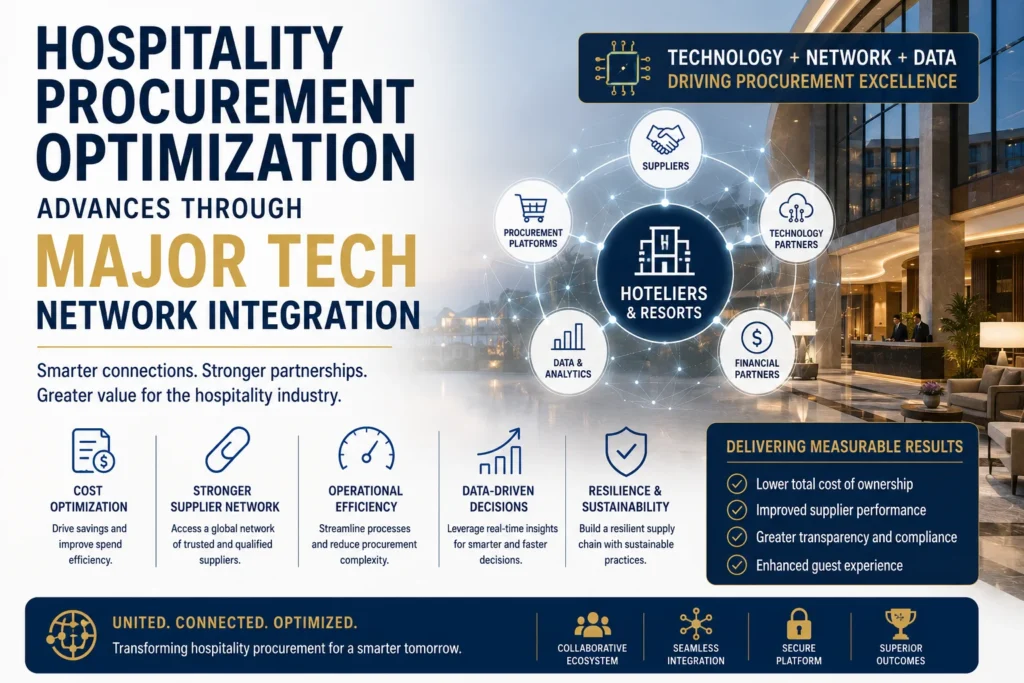
The administrative framework of global lodging operations is experiencing structural updates as financial software and logistics networks merge to mitigate rising operational costs. Folio, a hospitality-focused financial operations and supply chain software platform, has officially joined Avendra International’s Preferred eProcurement Solutions Network. This system alignment allows hotels, ownership groups, and destination management companies to integrate localized workflows with pre-negotiated volume purchasing agreements.
According to global tourism and hospitality operations framework data, managing back-of-house compliance has become a critical objective for properties looking to defend profit margins against fluctuating material prices and supply chain inconsistencies. Official reports indicate that while corporate offices invest considerable resources into establishing preferred vendor agreements, properties frequently suffer from contract leakage due to fragmented, manual ordering procedures. The newly formalized partnership addresses this vulnerability by embedding pre-negotiated program terms directly into everyday operational interfaces.
Sourcing Efficiency Tied to $20.5 Billion in Global Purchasing Power
The collaborative framework enables properties utilizing the connected digital architecture to gain immediate transparency over extensive commercial supplier catalogs. Official data published by international supply chain management registries notes that the infrastructure covers more than 5,000 contracted supplier programs. These programs leverage an aggregate $20.5 billion in localized and global procurement power, backed by deep supply chain infrastructure spanning dozens of countries and territories.
By introducing automated product matching and targeted compliance filters at the property level, the network aims to stabilize the procurement pipelines of diverse lodging properties, ranging from urban convention centers to remote leisure resorts. Regional tourism guidelines emphasize that standardized supply chains are necessary to maintain uniform service delivery, particularly during peak travel seasons. The technology handles transaction routing by highlighting approved items automatically, reducing the time buyers spend manually cross-referencing external inventory manifests.
Improving Operational Compliance at the Decision Interface
Unlike baseline accounting programs that focus solely on trailing invoice recording, modern hospitality procurement optimization relies on reshaping buying behaviors before transactions are approved. Official software design disclosures clarify that compliance is established by making pre-negotiated supplier channels the default option within the property’s local ordering pipeline. This structural guidance ensures that on-property departments buy directly from approved contracts without needing extensive administrative oversight.
The practical impact of this integrated methodology is demonstrated across initial portfolio rollouts managed by North American hospitality operators. Internal operational assessments reveal that properties integrating these automated buying guides recorded a major double-digit increase in contracted program participation, with compliant purchases rising by more than 10% across combined asset portfolios. This shift allows management companies to claim maximum negotiated rebates and volume-based discounts without altering their foundational vendor relationships.
Centralizing Back-Office Processes to Reduce Overhead
The development comes as global resort and hotel operators seek specialized financial tools to counter high utility and labor expenses. Modern procurement systems achieve savings by combining multiple separate clerical functions—including centralized market sourcing, digital inventory counts, asset accounting, automated bill scanning, and virtual corporate payment solutions—into a unified workflow. This consolidation reduces the hours property employees spend resolving billing errors and matching manual purchase orders with physical delivery receipts.
Official tracking metrics show that properties adopting these advanced corporate payment and inventory tools significantly lower their average transaction processing costs. The elimination of paperwork bottlenecks is crucial for regional hospitality groups managing large, multi-property portfolios, where single-digit improvements in compliance translate to major boosts in net operating income. Streamlining these daily operations allows properties to direct staff toward guest-facing service delivery rather than administrative compliance tasks.
The Future of Connected Procurement Infrastructure
As the travel industry adjusts to heightened corporate compliance standards and tighter operating environments, digital supply chain integration is becoming a standard feature of modern hospitality architecture. International hospitality infrastructure reports indicate that properties are increasingly prioritizing interconnected tech stacks that link property management, workforce scheduling, and product procurement into a unified data ecosystem.
The alliance between Folio and Avendra International highlights a industry-wide transition toward automated, data-informed asset management. By bridging the gap between localized purchasing workflows and vast global distribution networks, the collaboration establishes a highly efficient model for corporate lodging management. Moving forward, the widespread adoption of built-in compliance systems will remain a key strategy for tourism enterprises seeking to build resilient supply chains, maintain predictable operational margins, and deliver reliable guest experiences across the global travel landscape.
For more travel news like this, keep reading Global Travel Wire