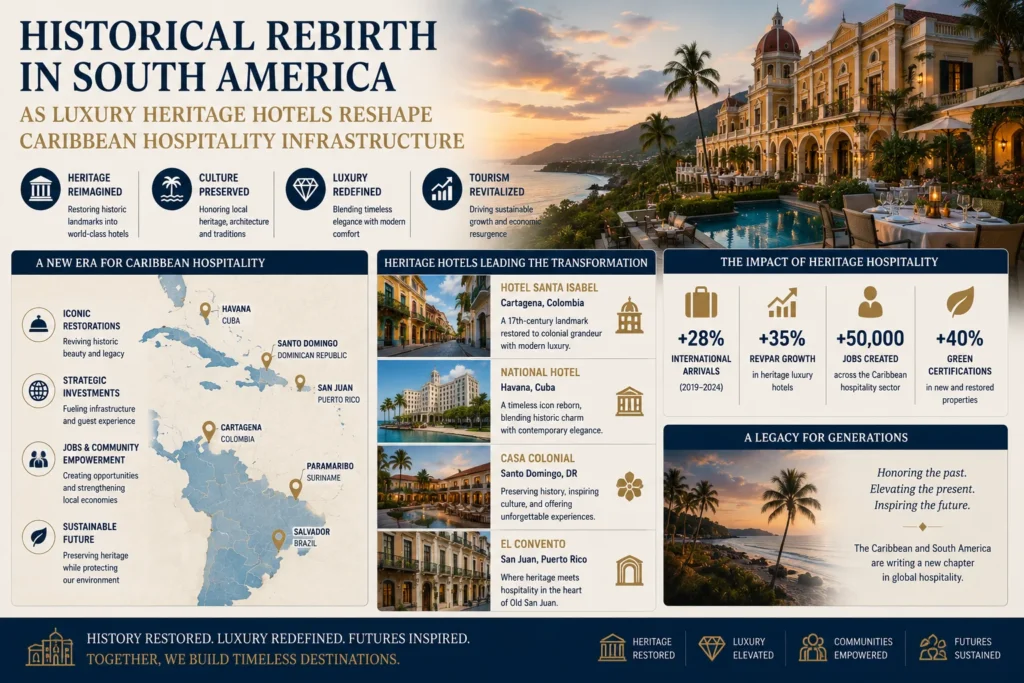
The historic architecture and high-end hospitality landscape of South America have marked a definitive evolutionary step with the official opening of the Four Seasons Hotel and Residences Cartagena. According to formal announcements from Colombia’s national tourism promotion agency, ProColombia, and regional development ministries, the completion of this extensive preservation project signals a multi-million-dollar upgrade to the country’s high-yield travel infrastructure. The introduction of this flagship property directly supports the national government’s master plan to diversify local economies through sustainable, culturally integrated hospitality initiatives.
Official macro-economic figures released by the Ministry of Commerce, Industry, and Tourism show that Colombia’s international travel sector has achieved record-breaking momentum, with the nation logging over ten.two million international movements. This robust volume establishes the country as the leading tourist destination in South America and the third largest in Latin America, outpaced only by Mexico and the Dominican Republic. Driven by an eighteen percent year-over-year surge in aviation connectivity and expanded long-haul flight networks from major global source markets, premium non-extractive sectors like high-end lodging now contribute between four point five and five percent of the national Gross Domestic Product, generating more than twenty-one billion dollars annually.
Architectural Stewardship and Cross-Continental Design Collaborations
The physical footprint of the new complex spans a carefully curated assembly of landmark structures, ranging from a sixteenth-century San Francisco cloister and temple to iconic mid-century civic spaces and the masterfully restored 1920s landmark Club Cartagena. This historic transformation was completed in structural coordination with San Francisco Investments, utilizing strict restoration protocols mandated by national heritage preservation laws to safeguard the original facades and stone masonry while integrating modern structural engineering.
The interior visual identity of the asset marks one of the final completed endeavors of the celebrated French designer, the late François Catroux, who formulated a design language blending European sophistication with authentic Colombian textures. To bring this vision to life, the development team mobilized an extensive consortium of international and domestic creative minds. Structural configuration and spatial planning were managed by global architectural firms WATG and Wimberly Interiors, while original dining layouts were conceptualized by AvroKO and French creative studio SBM Interior Design. The landscaping of the extensive rooftop gardens and interior courtyards was engineered by Switzerland’s Enea Landscape Architecture, under the direct operational leadership of Colombian landscape architect Carolina Jaimes.
The property acts as a showcase for indigenous craftsmanship, featuring curated contributions from notable Colombian master artisans. This includes hand-carved sculptural plaster relief installations by Alejandro Hernández, expansive landscape-inspired installations by Eloin Rivera, and bespoke room-by-room fine art pieces rendered by Miguel Cárdenas. Textile application and custom furniture components were explicitly developed by domestic designer Poli Mallarino, ensuring that over eighty percent of the visible interior finishings directly champion local artistic supply lines.
Multi-Tiered Accommodations and Dedicated Private Residential Wings
The premium property features one hundred and thirty-one guest accommodations tailored to different segments of the modern luxury leisure market. Within the historic core, twenty-seven deeply atmospheric colonial-style rooms and suites preserve original architectural components, such as vaulted ceilings and centuries-old exposed stone layouts. The pinnacle of the heritage collection is the Catroux Suite—the property’s presidential enclave—which features private elevator connectivity, expansive dual-bedroom floor plans, and a furnished open-air terrace centered around a handcrafted, Moorish-style ceramic fountain created by local artist María Cecilia Franco Berón.
Beyond the historic wings, quiet, light-filled interior courtyards lead to a collection of contemporary rooms and suites characterized by refined, minimalist design elements and vast floor-to-ceiling glass frames that maximize natural Caribbean light. For long-term international arrivals and investors seeking permanent property roots within the city, a highly limited selection of Private Residences was seamlessly incorporated into the master plan. Structured by Rodriguez Valencia Arquitectos, these high-end residential units grant owners unrestricted access to the complete suite of hotel services, dedicated concierge teams, and localized amenities.
Gastronomic Hubs and Ancestral Healing Frameworks in Getsemaní
The culinary footprint of the property spans eight independent restaurant and lounge venues, transforming the historic Getsemaní neighborhood into a standalone food and beverage destination. Nestled within the walls of the reimagined Club Cartagena, The Grand Grill delivers an elevated interpretation of steakhouse traditions featuring premium cuts and locally sourced seafood. The venue is paired with Bar Lelarge—named in honor of the original building architect Gastón Lelarge—which offers a specialized mixology program featuring seasonal Caribbean fruits and spirits inflected with subtle historical influences.
For panoramic leisure, El Palmar provides a three-hundred-and-sixty-degree rooftop escape, offering unobstructed views of the city’s historic fortifications and Caribbean sunsets. At the heart of the social framework sits Atrio, a lively lobby lounge set beneath a soaring glass atrium featuring striking black-and-white marble flooring and lush interior flora that mirrors old-world tropical aesthetics.
Wellness infrastructure is anchored by the Umari Spa, located within the peaceful stone corridors of the restored cloister. The facility introduces a contemporary therapeutic philosophy inspired by the native umari plant, combining modern dermatological science with ancestral Colombian healing traditions. The spa’s treatment menu relies on locally harvested botanicals and natural extracts, providing travelers with authentic wellness experiences. This is supplemented by a round-the-clock fitness pavilion hosting state-of-the-art movement equipment, personal training configurations, and a structured schedule of yoga and guided mobility sessions.
Specialized Meeting Venues Driving Regional Event Tourism
As Cartagena continues to elevate its global standing as a primary hub for international corporate events, the hotel introduces specialized event spaces capable of hosting high-profile assemblies, state ceremonies, and large-scale celebrations. The flagship venue is the Ballroom de la Veracruz, which easily accommodates up to three hundred delegates beneath a dark, vaulted ceiling accented by geometric checkerboard flooring. The hallmark of this venue is a raised performance platform topped by a meticulously uncovered, centuries-old fresco painting that serves as a historic backdrop for international speakers.
For mid-sized conventions, the Ballroom Centenario provides space for up to one hundred guests, utilizing a expansive wall of glass windows that overlooks the adjacent Parque Centenario with the iconic clock tower of the Walled City visible in the distance. Supported by the adjacent LeLarge breakout room and dedicated executive boardrooms, the venue provides a highly functional platform for corporate groups. Tourism statistics from the Cartagena de Indias Tourism Corporation indicate that world-class conference infrastructure, paired with proximity to a UNESCO World Heritage Site, will continue to expand the city’s market share in the global meeting and exhibition sector throughout the coming year.
For more travel news like this, keep reading Global Travel Wire