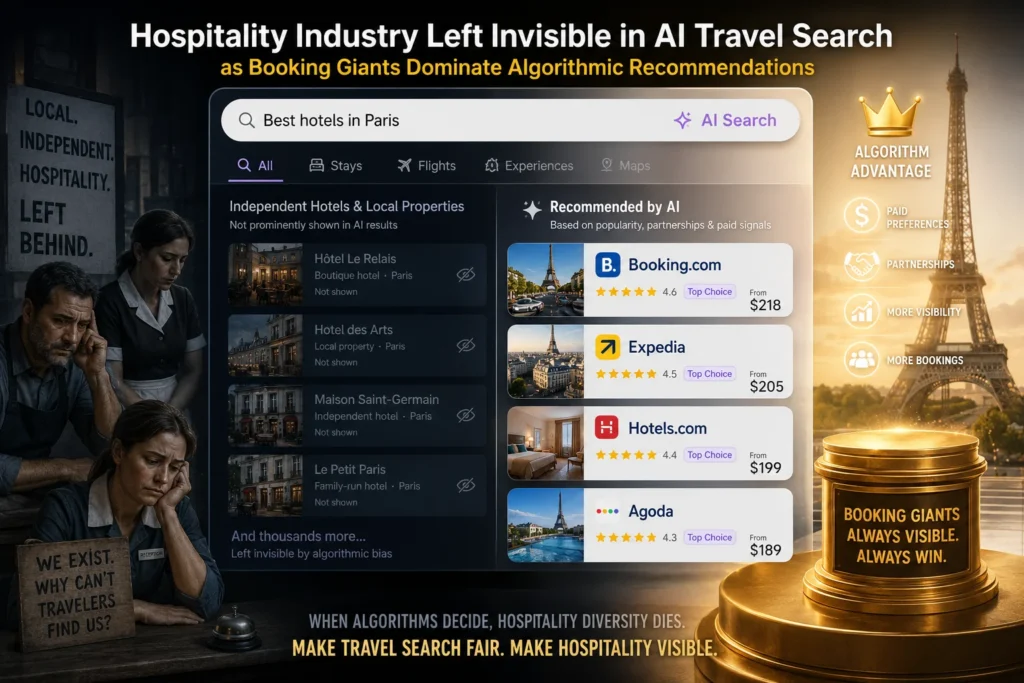
The rapid integration of artificial intelligence into consumer behavior is fundamentally shifting the mechanics of destination marketing and hospitality discovery. Speaking at the recent EHL HumanX Summit held at the EHL Hospitality Business School campus in Lausanne, Switzerland, industry pioneer Mirko Lalli delivered a clear assessment of the sector’s operational readiness for the artificial intelligence era. According to data shared during the summit, the hospitality sector faces a structural invisibility crisis within the emerging algorithmic ecosystem, with the vast majority of automated travel recommendations completely bypassing independent operators and traditional destination management organizations.
The data underscores a growing imbalance between consumer habits and hospitality data infrastructure. As travelers increasingly transition from traditional keyword search queries to conversational AI interfaces, the established digital channels that independent hotels, regional chains, and local tourism boards have relied upon for decades are experiencing unprecedented traffic retrenchment.
The Invisibility Crisis Shaping Modern Travel Discovery
The core of the challenge lies in how generative engines gather and synthesize information for consumers. Statistics compiled from international tourism indicators and digital tracking platforms reveal that approximately 60% of modern travelers now utilize artificial intelligence utilities to plan, research, or structure their travel itineraries. However, the automated responses generated by these engines are heavily centralized. Roughly 80% of the accommodation and itinerary suggestions returned by conversational AI tools originate directly from major online travel agencies and global booking conglomerates.
Consequently, independent properties, regional boutique brands, and local destinations remain largely absent from the generative conversation. Because the underlying large language models rely on vast, structured data aggregates compiled by dominant third-party distributors, individual hotel websites are frequently omitted from the final algorithmic output. For the modern consumer executing an AI-driven inquiry, these unrepresented hospitality businesses have effectively become digitally non-existent.
Shifting from Technical Frameworks to Content Strategy
Addressing this operational gap requires a conceptual shift rather than a purely financial or technological investment. Analysis of generative engine mechanics indicates that preparing a hospitality brand for artificial intelligence is roughly 30% technical and 70% content-driven. The technical component builds directly upon established Search Engine Optimization principles, requiring clean semantic web markup, structured data schema, and accessible site architecture to allow machine crawlers to index property attributes accurately.
The remaining 70% relies entirely on a comprehensive, narrative-driven content strategy. Consumer interaction with search utilities has evolved dramatically over the past decade; the average text query has lengthened from roughly five words to approximately 20 words, frequently driven by voice search and conversational language. Consumers are abandoning transactional search behaviors—such as entering a specific city and a rigid set of dates—in favor of expressive, mood-based queries.
This trend toward highly specific, intentional prompting requires hospitality websites to rebuild their semantic depth. While the design trends of the past decade favored minimalist layouts with stripped-back text, generative search engines require comprehensive, long-form written material to interpret context, ambiance, and unique property experiences. Consequently, contextual editorial content, descriptive regional guides, and specialized property weblogs are experiencing an industry-wide resurgence as vital tools to feed generative models the descriptive data they require.
Understanding the Realities of Zero-Click Search Metrics
The financial urgency of adopting Generative Engine Optimization, or GEO, is illustrated by shifting traffic patterns across major international reference points and public data repositories. Industry statistics reveal that organic web traffic to independent destination platforms has contracted sharply, with some regional tourism boards recording declines exceeding 60% in direct organic referrals. This contraction matches a broader international trend toward zero-click searches, an operational environment where the user receives a complete, synthesized answer directly within the AI interface, eliminating the need to click through to an external third-party website.
As organic search traffic transitions into internal engine interactions, the commercial models governing digital marketing are adapting accordingly. Preliminary tests of generative engine marketing protocols indicate high entry costs for early-stage sponsored placements within conversational outputs, presenting an obstacle for small-to-medium tourism enterprises. To maintain visibility without relying entirely on cost-prohibitive digital ad spend, hospitality providers must optimize their organic digital footprints to ensure their core information is easily read, synthesized, and recommended by conversational algorithms.
Overcoming Fragmented Regional Tech Structures
The challenge of achieving digital readiness varies significantly by geography, with the European hospitality sector encountering distinct structural and cultural hurdles. Operational data from European ministries of tourism and regional commerce registries point to a highly fragmented technology landscape. In contrast to highly consolidated markets, regions like Italy and Central Europe are characterized by an abundance of small, independent, family-run hospitality businesses operating on legacy software stacks.
This administrative fragmentation creates significant operational friction; it is common for a single geographic tourism region to feature dozens of distinct property management systems that do not communicate or standardize data efficiently. This lack of centralized data harmony, combined with rigid regulatory compliance frameworks, has slowed the adoption of automated data syndication. While international technology infrastructures accelerate at an exponential rate, local hospitality providers risk falling further behind if their core operational data remains locked within incompatible, offline databases.
Elevating the Human Connection as the Ultimate Premium Service
Despite the technical imperatives dominating current industry discussions, the ultimate long-term strategy for hospitality operators relies on a balanced distribution of labor between machine intelligence and human personnel. Industry leaders emphasize that artificial intelligence should be leveraged extensively to handle predictable, administrative, and repetitive operational tasks. Automating check-in confirmations, basic reservation adjustments, and standardized guest inquiries frees up significant administrative bandwidth for on-property teams.
By delegating routine logistics to automated systems, hospitality providers can reinvest their human capital into delivering authentic, personalized guest experiences. As consumers become thoroughly accustomed to automated interactions in their daily lives, unscripted human connection, localized cultural identity, and genuine empathy are emerging as rare, premium differentiators. For an industry fundamentally rooted in human relationships, the strategic deployment of technology serves not to replace personal service, but to protect it—positioning authentic hospitality as the definitive luxury standard in an automated world.
For more travel news like this, keep reading Global Travel Wire