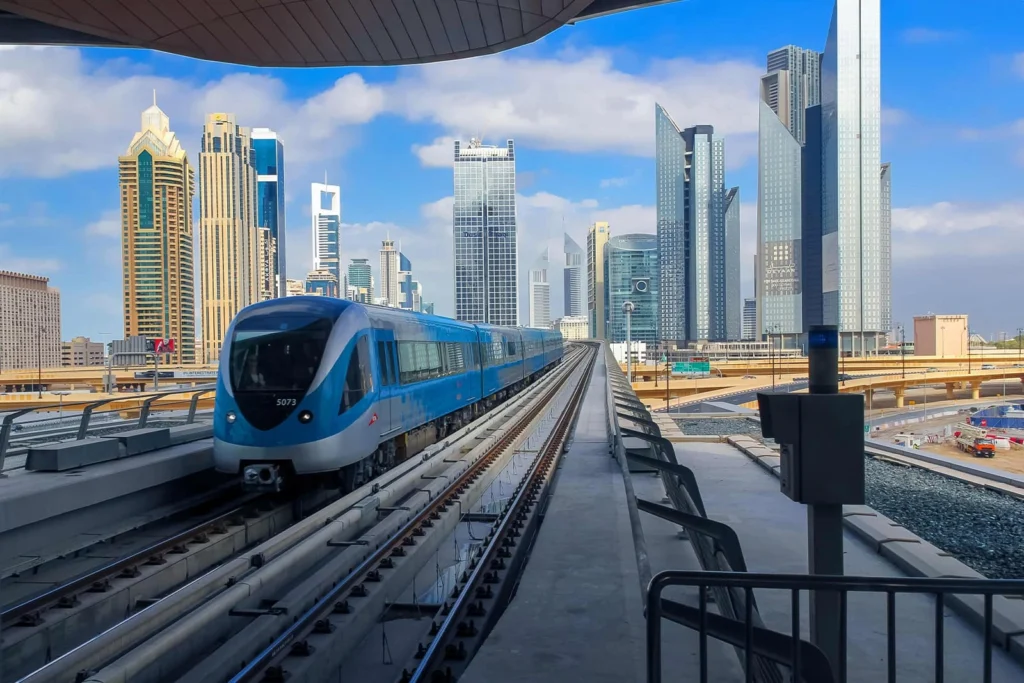
Dubai has officially advanced one of its most ambitious transportation infrastructure projects with the approval of the Dubai Metro Gold Line, a major underground rail expansion designed to strengthen urban connectivity, support economic growth, and reshape future development across the emirate.
Approved on April 22, 2026, the AED 34 billion metro project forms part of Dubai’s long-term strategy to expand high-capacity public transportation while improving mobility between major residential districts, commercial hubs, and emerging development corridors.
The Roads and Transport Authority (RTA) will oversee the development as part of Dubai’s broader urban planning framework focused on sustainability, integrated mobility, and long-term economic competitiveness.
Once completed, the Gold Line is expected to become one of the most important additions to Dubai’s transportation network, supporting both residents and visitors across rapidly growing parts of the city.
New Underground Metro Corridor to Span Forty-Two Kilometres
The Dubai Metro Gold Line will extend approximately 42 kilometres and include 18 underground stations connecting multiple key districts throughout the emirate.
The fully underground design was selected to minimize disruption within high-density urban zones while maximizing operational efficiency and long-term scalability.
Officials say the new line will connect around 15 major districts and provide direct access to more than 55 active development projects currently underway across Dubai.
The route is expected to serve approximately 1.5 million residents once operational, significantly increasing the city’s overall public transportation capacity.
The underground approach also aligns with Dubai’s wider sustainability goals by supporting high-density transit-oriented urban development while preserving surface-level infrastructure and city landscapes.
Key Business and Residential Districts to Gain Direct Access
The Gold Line will pass through several of Dubai’s fastest-growing economic and residential areas including Business Bay, City Walk, Meydan, Jumeirah Village Circle, and Jumeirah Golf Estates.
These districts represent some of Dubai’s most active real estate and commercial growth corridors, with ongoing investments in mixed-use developments, residential communities, hospitality projects, and retail infrastructure.
The line will also integrate with the existing metro network through planned interchange stations connecting with the Red Line at Business Bay and Jumeirah Golf Estates and the Green Line at Al Ghubaiba.
These interchange connections are expected to improve passenger movement across the broader metro system while reducing travel times between key destinations throughout the city.
Long-term plans also include integration with future regional rail infrastructure to strengthen inter-emirate transportation links and improve connectivity beyond Dubai itself.
Metro Expansion Expected to Ease Traffic Congestion
One of the primary objectives of the Gold Line project is to reduce pressure on Dubai’s increasingly congested road networks.
As population growth and urban expansion continue accelerating, transportation authorities are seeking to shift more residents toward public transit solutions capable of handling rising commuter volumes efficiently.
The addition of a new high-frequency east-west metro corridor is expected to distribute passenger traffic more evenly throughout the transportation system while reducing dependency on private vehicles.
Transportation planners believe the project will improve mobility within some of Dubai’s busiest urban corridors where traffic congestion has intensified due to rapid development and increasing commuting demand.
The Gold Line will also complement the city’s existing metro infrastructure by creating a more balanced transportation network capable of supporting future urban growth.
Dubai Aligns Metro Expansion With Long-Term Urban Vision
The project forms a central part of Dubai’s broader urban development strategy aimed at creating a more connected and multi-centered metropolitan structure.
Rather than relying heavily on a single commercial core, Dubai’s long-term planning vision focuses on developing multiple integrated urban centers supported by high-quality transportation infrastructure.
The Gold Line supports this strategy by encouraging higher-density development around transit-accessible communities while improving connectivity between residential, commercial, and employment zones.
Urban planners believe this transit-oriented development approach can improve land-use efficiency, reduce travel times, and support long-term sustainability goals across the emirate.
By expanding metro access into developing districts, Dubai is also attempting to guide future population growth in a more structured and infrastructure-supported manner.
Real Estate Sector Expected to Benefit From Improved Connectivity
The Gold Line is already generating strong attention within Dubai’s real estate market as investors anticipate increased demand for properties located near future metro stations.
Transportation infrastructure projects have historically had significant influence on property values throughout Dubai, particularly in metro-linked communities offering improved accessibility and shorter commuting times.
Early projections suggest residential and commercial property values along the Gold Line corridor could increase by as much as 20 percent after the line becomes operational.
Areas including Business Bay, Meydan, and Jumeirah Village Circle are expected to attract heightened investor interest due to their direct integration into the expanded metro network.
Improved connectivity may also support stronger rental demand in metro-accessible neighborhoods, particularly among professionals prioritizing efficient commuting options.
Economic Growth and Tourism Connectivity Receive Additional Boost
Beyond transportation improvements, the Gold Line is expected to generate wider economic benefits across multiple sectors.
Improved mobility can strengthen access to employment centers, retail destinations, tourism zones, and commercial districts while reducing travel-related inefficiencies throughout the city.
Construction activity tied to the project is also expected to support employment and economic output during the development phase through increased demand across engineering, construction, logistics, and infrastructure industries.
The expanded metro system is likely to enhance Dubai’s tourism ecosystem as well by improving visitor access to hotels, attractions, shopping districts, and entertainment destinations spread throughout the emirate.
Dubai Targets 2032 Completion for Landmark Metro Project
The Gold Line is scheduled for completion in September 2032 and is expected to become a defining component of Dubai’s future transportation infrastructure.
Officials view the project as a long-term investment in sustainable urban mobility capable of supporting continued population growth, economic expansion, and evolving transportation demands across the city.
As Dubai continues positioning itself as a leading global business, tourism, and investment hub, the Gold Line is expected to play a critical role in shaping future development patterns and reinforcing the emirate’s reputation for world-class infrastructure and integrated urban planning.
For more travel news like this, keep reading Global Travel Wire