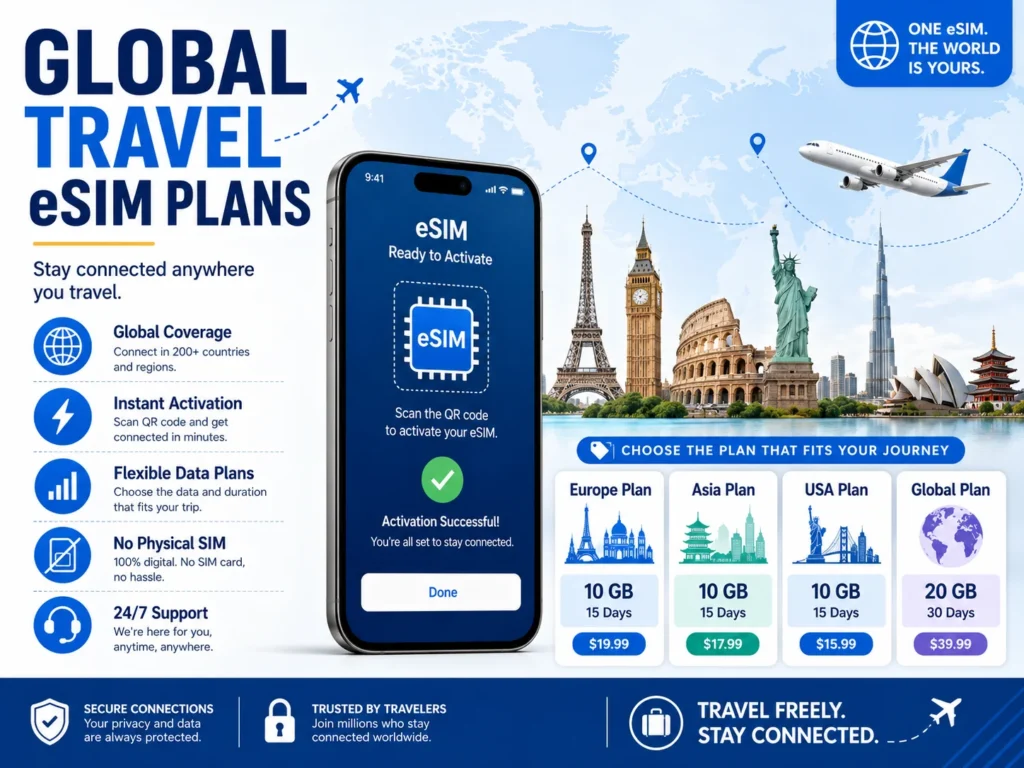
Navigating mobile connectivity while exploring overseas destinations has long been a logistical and financial hurdle for international tourists. Historically, travelers were forced to choose between exorbitant carrier roaming fees, insecure public wireless networks, or the physical hassle of purchasing local plastic SIM cards at airport kiosks. In a major structural shift aimed at lowering the entry barriers for digital cellular technology, Australian telecommunications firm BazTel has officially announced the launch of ultra-affordable global travel eSIM plans. The introductory initiative introduces entry-level data packages priced at one dollar for one gigabyte of data, directly targeting the world’s most heavily traversed leisure and commercial transit corridors.
The rollout is strategically timed to coincide with the high-volume northern hemisphere summer travel segment. By anchoring operations across a digital-first infrastructure, the telecommunications provider has extended its service grid to cover more than 160 countries. This synchronized deployment seeks to democratize cellular data access, transforming standard smartphone connectivity from a premium vacation luxury into an accessible, baseline security utility for families, corporate commuters, and digital nomads moving through intercontinental flight paths.
Targeting Major Travel Corridors Across Asia, Europe, and the United States
The introductory data framework focuses heavily on high-yield international tourist hubs where travelers routinely face unexpected digital isolation. According to global tourism statistics, outbound passenger volumes across transpacific and transatlantic routes have climbed steadily, intensifying the demand for immediate, reliable airside data access upon landing.
The expanded network coverage applies comprehensively to prominent East Asian and Southeast Asian destinations. Travelers moving through the high-tech urban corridors of Tokyo, Seoul, Hong Kong, and Singapore, or exploring the cultural landscapes of Thailand and Vietnam, can access local network parameters instantly. Furthermore, the operational network blankets mainland China, providing international visitors with a private data line crucial for operating vital localized translation and digital mapping systems.
Beyond the Asian continent, the one-dollar data initiative encompasses the extensive European transit grid, including popular Mediterranean holiday markets and transcontinental hubs like Turkey. The framework also covers the United States domestic network, ensuring that multi-destination international travelers maintain continuous high-speed data access without needing to swap hardware profiles or configure independent regional accounts as they cross geographic boundaries.
Overcoming Adoption Barriers Through Browser-Based Onboarding
Despite the clear financial advantages of embedded subscriber identity module (eSIM) technology over traditional cellular roaming, public infrastructure reports indicate that a significant percentage of international vacationers remain hesitant to adopt digital cellular profiles. Common technical friction points include general unfamiliarity with digital profile installation, uncertainty regarding individual device compatibility, and an unwillingness to invest substantial funds into unfamiliar software products.
To directly address these operational bottlenecks, the telecommunications platform has integrated a proprietary browser-based dashboard system. Traditional digital SIM setups typically require passengers to scan complex QR codes using a secondary screen, download specialized standalone mobile applications, or manually input dense cryptographic string variables into deep device sub-menus.
The updated interface allows international travelers to complete registration, verify hardware compatibility, and download active network profiles via a standard web browser with a single click. This simplified onboarding protocol operates independently of companion applications or hardware cards, enabling first-time international visitors, families, and senior travelers to secure active data lines prior to boarding, during mid-trip layovers, or immediately upon arriving at their terminal gate.
Technical Frameworks and Global Network Infrastructure
From an operational perspective, delivering high-performance cellular service at an entry-level price tier relies heavily on robust international wholesale carrier agreements. Public telecommunications data outlines how roaming service providers utilize local cellular infrastructure to deliver data traffic. The platform interfaces dynamically with localized network operators on six continents, securing authenticated access to standard 4G and high-bandwidth 5G cellular frequencies wherever the technologies are locally active.
Aviation and travel safety authorities emphasize that maintaining a dedicated, private cellular connection significantly enhances personal safety throughout the international travel lifecycle. Relying exclusively on open-access terminal wireless networks exposes mobile devices to verified cybersecurity vulnerabilities, data interception, and unstable bandwidth. Having immediate access to local cellular towers facilitates smooth airport transfers, enables real-time transport booking, and preserves instant access to domestic emergency contact networks from the exact moment an aircraft completes its taxi sequence.
As global smartphone manufacturers increasingly transition toward eSIM-exclusive hardware designs—completely removing physical card slots from premium device models—the consumer demand for flexible, software-driven cellular profiles is projected to scale aggressively. Regulatory tracking briefs estimate that the global user base for digital travel profiles will expand significantly over the next four years, growing from roughly 40 million active consumers to a projected baseline exceeding 215 million users by the end of the decade. This initial promotional structure establishes a highly competitive precedent, showing that secure, high-speed international data can remain both technically accessible and financially sustainable for modern global explorers.
For more travel news like this, keep reading Global Travel Wire