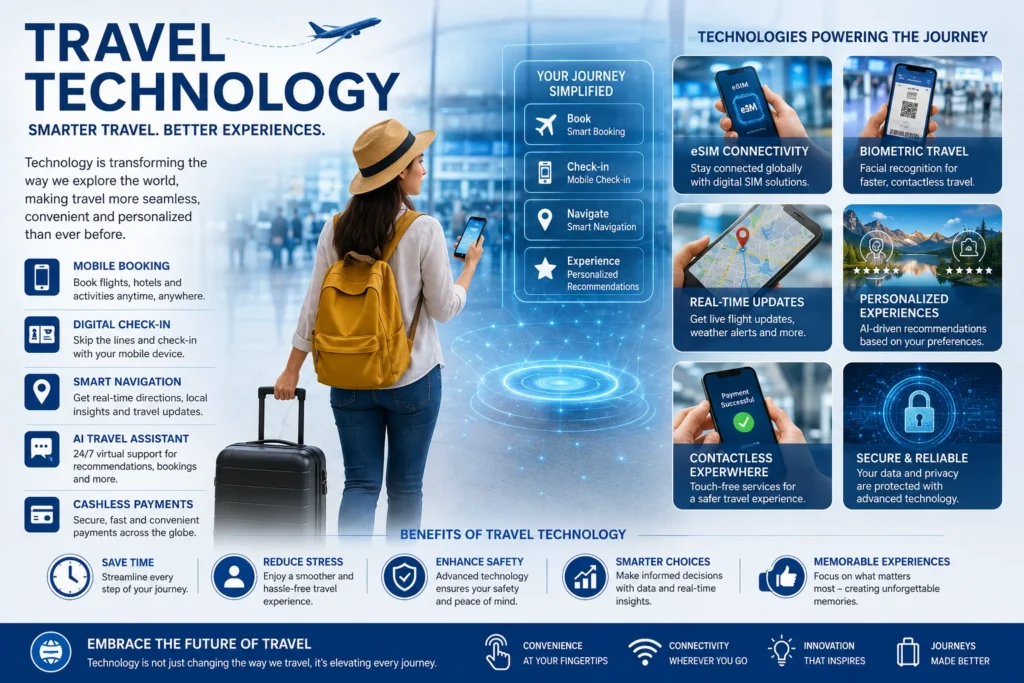
Mobile connectivity has fundamentally shifted from a premium convenience into a core structural requirement for global travelers. In an era where a passenger’s smartphone serves as a comprehensive travel command center, the presence of stable, high-bandwidth digital infrastructure heavily shapes destination competitiveness, passenger booking choices, and consumer brand loyalty. This industry evolution reflects how deeply integrated remote work and digital-dependent logistics have become within the modern travel sector.
Recent statistical insights issued by global administrative bodies underscore this reliance on cellular networks. According to digital infrastructure performance tracking databases maintained by the International Telecommunication Union (ITU), approximately 6 billion people—roughly three-quarters of the global population—are actively utilizing internet infrastructure. Crucially, the deployment of advanced mobile telecommunications networks has crossed a significant threshold, with 5G infrastructure now covering 55 percent of the global population and accounting for over one-third of all active mobile broadband profiles. As a result, travelers who navigate daily life using high-performance cellular networks expect equivalent data standards when crossing international borders.
The Trust Factor: Digital Infrastructure as a Baseline Hospitality Standard
Consumer trust in modern hospitality services is now deeply intertwined with the quality of localized wireless ecosystems. When international tourists experience network dropouts, late text transmissions, or unresponsive mobile applications, they routinely question the operational professionalism and safety standards of their hosting provider or municipal transit network. This correlation between digital performance and brand reliability has become a deciding factor for destination management offices worldwide.
Financial security represents a critical dimension of this digital trust framework. The modern travel lifecycle depends on secure, uninterrupted access to local networks to process secure contactless credit card payments, access biometric digital identification wallets, and verify flight boarding details at security checkpoints. Unstable or unencrypted connection portals can expose personal data to digital interference or transmission errors, which heavily undermines consumer confidence in local retail and tourism spaces.
Furthermore, data from global tourism investment conferences indicates that hospitality groups and destination networks that explicitly clarify their technical service parameters—providing verified coverage maps, network speed benchmarks, and dedicated on-site IT support channels—receive measurably higher repeat bookings and consumer trust scores compared to operators that offer ambiguous connectivity claims.
Empowering Mobile-First Planning and On-the-Ground Navigation
The complete transition to mobile-first travel management has introduced several highly connectivity-dependent terminal habits. International travelers now manage every stage of their holiday itineraries via proprietary airline software, digital hospitality portals, and cloud-based transport schedulers. When a passenger steps clear of an arrival gate, the immediate availability of airside data becomes critical to managing the transit environment smoothly.
Location-based mobile services have transitioned into baseline survival utilities rather than simple travel luxuries. Real-time geographical mapping applications, public transit timetables, localized translation engines, and direct emergency notification systems rely entirely on steady cellular frequencies to operate effectively. If an international traveler arrives in a foreign municipality without accessible mobile networks, they face substantial logistical friction, creating an isolation barrier that can dampen overall visitor satisfaction and limit exploration beyond traditional resort boundaries.
Boosting Regional Competitiveness via Digital Infrastructure Modernization
National tourism boards are increasingly managing digital connectivity networks as primary economic drivers. Municipalities and island territories that invest heavily in upgrading public wireless networks and expanding localized 5G coverage corridors are realizing distinct competitive advantages, showing longer average visitor stays and attracting higher-spending demographic segments.
This infrastructure modernization is especially visible among emerging economies, which are leveraging cellular expansion to capture the rising global segment of digital nomads and remote corporate professionals. The capacity to join high-definition corporate video conferences and maintain operational data lines while residing in remote coastal or rural locations has turned digital infrastructure into a key deciding factor for long-term stay planning.
To capitalize on these demographic trends, international resort chains and municipal development boards are formalizing specific connectivity guarantees. These institutional frameworks treat data access like any standard utility—such as clean water or electricity—integrating automated network backups, dedicated business centers, and baseline speed guarantees directly into their consumer safety pledges.
Practical Management Tips for Connected Travel
As global tourism hubs adapt to heavily monitored, technology-driven operational frameworks, international passengers must adopt smart, self-reliant travel habits to safeguard their digital access. Implementing simple technical precautions ensures a smooth cross-border transition:
Verify Infrastructure Before Booking: Review official destination tourism portals and check for localized data summaries detailing regional cellular network performance and terminal coverage capabilities.
Integrate Backup Data Profiles: Secure independent connectivity solutions—such as downloadable digital travel profiles, standalone portable hotspots, or global roaming packages—before boarding an international route.
Confirm Accommodation Inclusions: Coordinate directly with hospitality providers to confirm their actual network parameters, specific speed guarantees, and the security protocols used for guest wireless networks.
Conduct Immediate Connectivity Tests: Verify that all essential personal and work hardware assets interface correctly with host networks within the first hour of arrival to address technical issues early.
By treating digital connectivity as a core component of travel safety and itinerary planning, modern travelers can explore the world with maximum confidence, protected from unexpected administrative blocks or logistical delays at the border.
For more travel news like this, keep reading Global Travel Wire