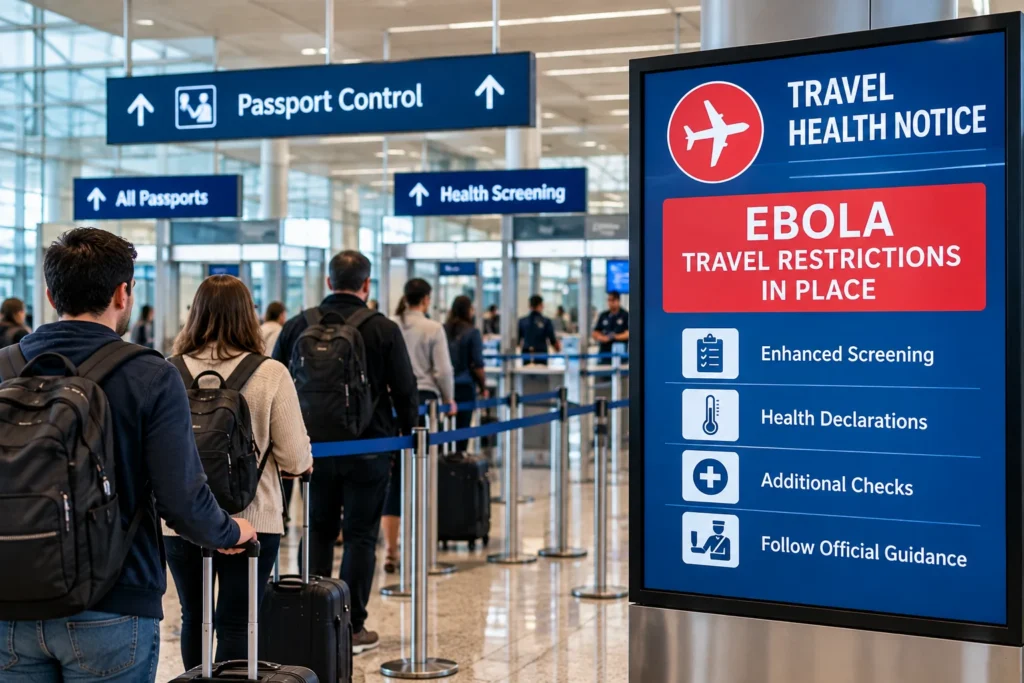
Nations across North America, the Middle East, Asia-Pacific, the Caribbean, and Africa have enacted targeted border entry measures and health screening protocols to prevent the international transmission of Ebola. Official announcements from health ministries, civil aviation authorities, and public health agencies confirm that temporary travel bans, mandatory 21-day quarantines, visa suspensions, and enhanced screening requirements are now active across multiple international border checkpoints.
Complete Suspension of Entry for Affected Regions
Several national governments have enacted immediate entry bans for foreign nationals arriving directly from or maintaining recent travel history in designated high-risk outbreak zones, specifically the Democratic Republic of Congo (DRC), Uganda, and South Sudan.
Official directives outline strict entry restrictions implemented by foreign ministries and immigration departments:
Canada: Has extended temporary public health measures through November 27, 2026. Foreign nationals present in the DRC within the preceding 21 days are prohibited from entering, with commercial air carriers instructed to deny boarding. Approved temporary resident visas, electronic travel authorizations (eTAs), and permanent resident visas for residents of affected countries remain suspended.
Saudi Arabia: Has suspended all travel by Saudi nationals to the DRC, Uganda, and South Sudan. The Ministry has also paused the issuance of all visa categories and barred entry for arriving travelers who visited these regions within 21 days prior to arrival, including those traveling via third-country transit routes.
United Arab Emirates: Suspended the issuance of new visas, including visit visas, for nationals of the DRC, Uganda, and South Sudan. Entry is restricted for travelers arriving from or transiting through these countries unless they have spent at least 21 consecutive days outside the affected areas.
Israel, Qatar, & Kuwait: Implemented comprehensive entry bans for non-citizens and non-residents arriving from or having visited the DRC, South Sudan, or Uganda within the past 21 days. Kuwait’s restriction applies to all connection routes regardless of initial departure point.
Jordan & Curacao: Banned entry for travelers arriving directly from or having visited the DRC or Uganda in the preceding 21 days. Curacao has extended entry bans to nationals of Angola, DRC, Rwanda, South Sudan, Tanzania, and Uganda, refusing visa processing and requiring a minimum six-month residency in the Netherlands before entry eligibility is considered.
Lebanon & Taiwan: Restricted entry for foreign nationals of the DRC and Uganda. Taiwan’s exemptions apply strictly to passport holders, resident certificate holders, admitted degree students, and immediate family members.
Mandatory Medical Screening and Surveillance Protocols
For destinations permitting entry or accommodating returning citizens, health ministries have instituted rigorous screening protocols and active monitoring periods ranging from 21 to 30 days.
Public health screening mandates outline operational steps across primary international transit gateways:
India: The Ministry of Civil Aviation launched the Air Suvidha 2.0 self-declaration portal. All arriving international passengers must submit an online health self-declaration covering 21-day travel history, exposure risks, and symptoms prior to immigration clearance, presenting the generated acknowledgment to airport health desks upon arrival.
Philippines: Mandates medical screening upon arrival for travelers with recent travel history to affected countries. Symptomatic travelers or individuals with known exposures undergo mandatory 21-day quarantine at Bureau of Quarantine facilities, while asymptomatic travelers undergo daily local surveillance for 21 days.
Thailand: Designated Bangkok Suvarnabhumi International Airport as the exclusive entry port for travelers arriving from the DRC or Uganda, subjecting passengers and airline crew to mandatory daily medical screening or quarantine for up to 21 days.
Trinidad and Tobago & The Bahamas: Enforced mandatory airport health screenings for arrivals with recent travel history in affected zones, subjecting passengers to immediate active health monitoring, quarantine, or isolation based on clinical assessment.
Regional Transit and Border Enforcement Measures
African nations and regional travel hubs have implemented targeted border controls to protect domestic public health and manage regional transit flows.
Official announcements from regional health and border authorities detail local operational constraints:
Uganda: Border crossings along the Uganda–DRC frontier are strictly restricted to essential personnel, including humanitarian workers and freight drivers, following screening. Non-essential travelers attempting entry are turned back at their own expense, while returning Ugandan nationals face mandatory 21-day quarantine. Passenger transit through Uganda for individuals with recent DRC travel history is prohibited across all transport modes.
Rwanda: Suspended entry for all travelers who have visited or transited through the DRC within 30 days prior to travel, requiring returning Rwandan nationals and permanent residents to undergo mandatory quarantine.
Mauritius: Suspended entry for business and tourist travelers who visited or transited through the DRC, South Sudan, or Uganda within 21 days prior to arrival, requiring returning Mauritian citizens and permit holders to undergo a mandatory 21-day quarantine.
Civil aviation agencies advice international travelers to check real-time embassy notices and allow extra time for airport health screening procedures.
For more travel news like this, keep reading Global Travel Wire