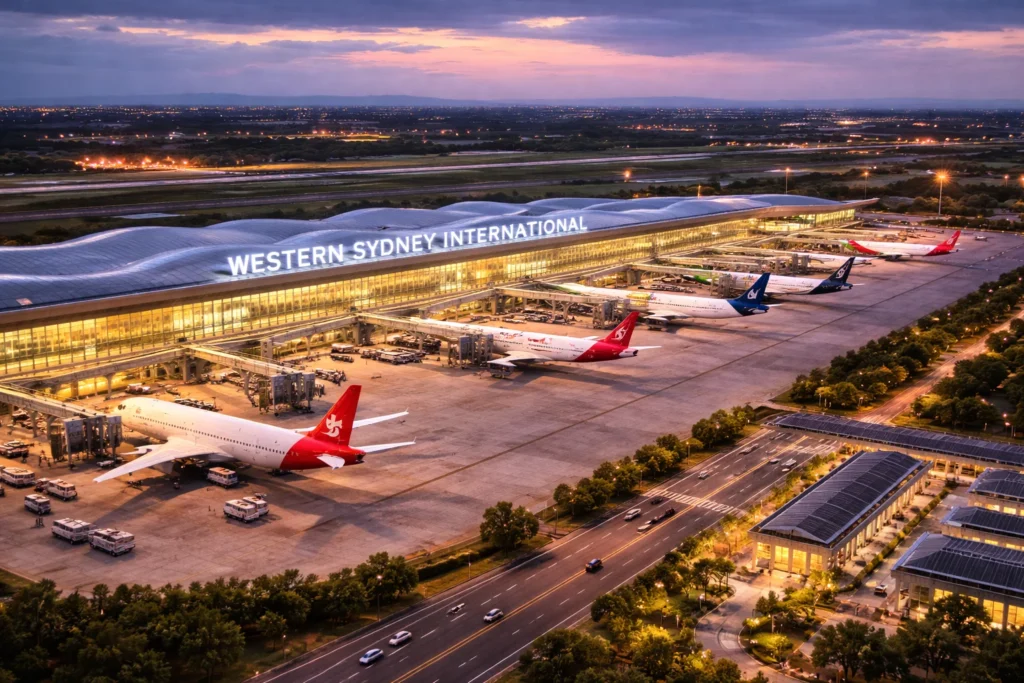
Australia’s newest aviation gateway, Western Sydney International Airport, is already influencing airline strategy and tourism planning even before its first passenger flight takes off. Scheduled to open in late 2026, the airport is set to become Sydney’s first major 24-hour airport with no curfew and no movement cap, offering airlines a level of scheduling freedom the city has never experienced at scale in the modern jet era.
This operational flexibility is expected to reshape flight networks, improve passenger connectivity, expand cargo capacity, and unlock fresh tourism opportunities across Greater Sydney and beyond. For travelers, airlines, and tourism businesses, the airport represents far more than additional runway space. It marks a structural shift in how Australia’s largest city can be served.
With major carriers already committing services and billions invested in surrounding infrastructure, Western Sydney International is emerging as one of the most significant tourism and transport developments in Australia.
A New Airport for a Growing Region
Western Sydney International, officially named Western Sydney International (Nancy-Bird Walton) Airport, is being developed at Badgerys Creek in one of the fastest-growing parts of metropolitan Sydney.
The region has long needed improved aviation access as population growth, business development, and tourism demand continue to rise. Until now, Sydney’s aviation market has largely relied on Kingsford Smith Airport, where curfews and movement caps have shaped airline schedules for decades.
The new airport changes that equation by adding a modern facility designed from the start for long-term expansion.
When it opens, the airport will begin with a single runway and an integrated domestic-international terminal capable of handling around 10 million passengers annually, with future plans for much larger capacity.
Why a 24/7 Airport Matters
The most important feature of Western Sydney International is not simply its size but its unrestricted operating model. A curfew-free airport allows airlines to schedule flights at times that better suit network connections, aircraft utilization, and customer demand.
This can create major benefits such as:
- Late-night departures
- Early-morning arrivals
- Better long-haul connection windows
- More efficient aircraft rotations
- Reduced congestion during peak hours
- Greater scheduling flexibility year-round
For international carriers especially, these freedoms can significantly improve how Sydney fits into global route networks.
Airlines Are Already Responding
Even before launch, airlines are adjusting plans around the new airport. Singapore Airlines has positioned Western Sydney International for an additional Sydney service, using late-night scheduling opportunities that are difficult to achieve under traditional restrictions elsewhere in the city.
This move highlights how airport design and operating rules can directly influence airline network decisions years before maturity.
Other early commitments include Qantas, Jetstar, and Air New Zealand, showing confidence in the airport’s ability to generate immediate traffic rather than serving only as a long-term overflow facility.
The presence of both domestic and international airlines from day one is an important signal for tourism growth.
Strong Domestic Tourism Potential
The Qantas Group is expected to establish a major initial presence through Qantas and Jetstar operations. Domestic routes linking Western Sydney with Melbourne, Brisbane, the Gold Coast, and other high-demand markets can support both business and leisure travel.
For Australian tourism, this means:
- Easier city-break travel
- Stronger domestic competition
- More affordable leisure options
- Better access for Western Sydney residents
- Increased visitor flows across states
Low-cost and full-service airline combinations can also stimulate new demand by appealing to different traveler segments.
This gives the airport a balanced identity from the beginning.
International Tourism Growth Opportunities
Internationally, Western Sydney International is expected to develop gradually but strategically. Early routes to Singapore and Auckland provide strong utility because they connect the airport to major regional hubs and popular travel markets.
Singapore offers onward access across Asia, Europe, and beyond, while Auckland creates an important trans-Tasman link.
As the airport grows, it may attract more carriers seeking schedule flexibility and access to Western Sydney’s large catchment area.
Potential future opportunities could include:
- Gulf hub connections
- Southeast Asia low-cost routes
- Expanded New Zealand services
- Additional Asian gateways
- Long-haul leisure links
This broad potential can help diversify Sydney’s tourism access points.
Cargo and Trade Benefits Support Tourism Too
Cargo operations are also expected to play a major role, with the airport helping expand Sydney’s freight capacity. Strong cargo networks support tourism indirectly by improving supply chains for hospitality, retail, food imports, exports, and airport services.
A thriving logistics ecosystem can strengthen regional business confidence and create jobs that support wider economic growth.
Modern airports increasingly succeed when they combine passenger demand with strong freight capability, and Western Sydney International is being positioned to do both.
Billions Invested in Connectivity
The airport is supported by major transport infrastructure, including rail and road links designed to connect it efficiently with surrounding communities and the wider Sydney region.
This is crucial because airport success depends not only on flights but also on how easily travelers can reach terminals.
Improved access can encourage:
- Faster transfers
- Better commuter links
- More hotel development
- Conference and event growth
- Tourism investment in nearby districts
Integrated transport planning makes the airport more attractive for both airlines and passengers.
Why This Matters for Tourism
For tourism, Western Sydney International represents a chance to distribute visitor growth more effectively across the city. Travelers arriving through the new airport may explore attractions, hotels, dining districts, and experiences in western and central Sydney that previously saw fewer direct aviation benefits.
The airport can also strengthen Sydney’s competitiveness against other Asia-Pacific gateways by offering more flexible schedules and additional capacity.
In a world where travelers value convenience and airline choice, these advantages matter greatly.
Looking Ahead to 2026 and Beyond
Western Sydney International is months away from opening, yet it is already changing how airlines think about Sydney. That alone shows the scale of its impact.
With 24/7 operations, expanding carrier commitments, cargo growth, and major transport investment, the airport is set to become a powerful new engine for tourism and connectivity.
For travelers, it means more flight options and easier journeys. For Sydney, it means a second aviation gateway built for the future. For Australia’s tourism industry, it could be one of the most transformative developments of the decade.
For more travel news like this, keep reading Global Travel Wire